


Artificial intelligence is creating something much larger than a technology boom.
It is creating an electrical construction boom.
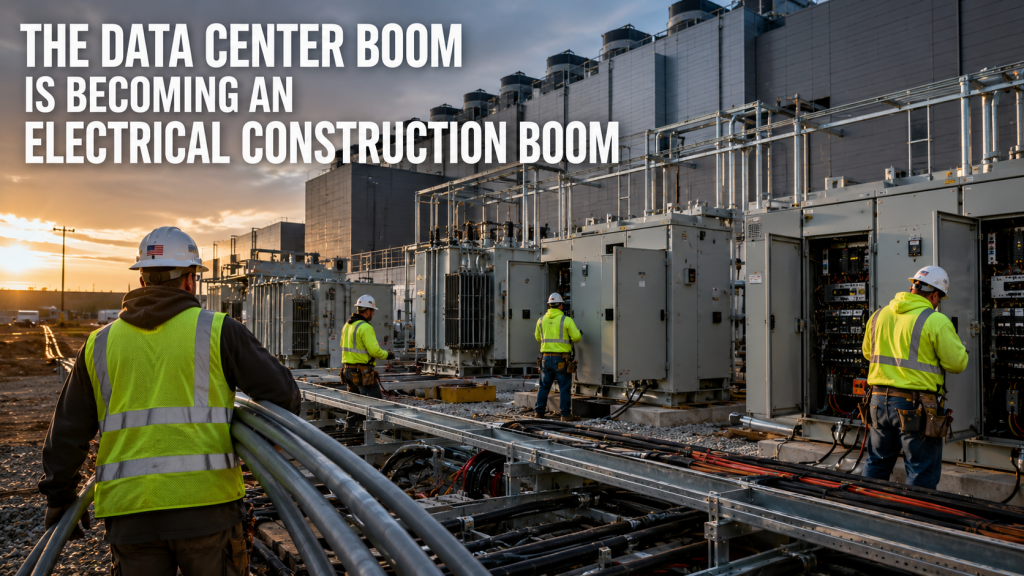
Across the United States, billions of dollars are flowing into new data centers and the infrastructure required to power them. These facilities require enormous electrical systems, including substations, transformers, medium-voltage distribution, switchgear, generators, UPS systems, busway, cable, controls and grounding systems.
For electrical contractors, estimators, project managers and suppliers, this could become one of the most important construction markets of the decade.
The evidence is already appearing throughout the electrical supply chain.
Reuters reported on August 19, 2026, that manufacturers ranging from generator companies to transformer and cable suppliers are benefiting from the rapid expansion of U.S. data centers. One of the clearest examples is Generac, which is investing heavily to increase production of large commercial generators used by data centers.
But generators represent only one part of a much larger opportunity.
Generac’s $1.6 Billion Data Center Backlog Shows the Scale of Demand
Consider what is happening at Generac.
Generac has traditionally been widely associated with standby generators for homes and businesses. Now the company is becoming a significant supplier to the hyperscale data center market.
Generac reported that its backlog for products serving data centers had reached approximately $1.6 billion by July 29, 2026. The company also said it received approximately $1 billion in additional orders from new and existing customers since its previous update.
That is not speculative future demand.
Those are orders.
Generac also finalized product-specific terms under an agreement with a hyperscale data center operator that committed nearly $700 million of volume for 2027. The company announced another global supply agreement with a second hyperscale customer in June.
The effect is showing up in Generac’s financial results.
Commercial and Industrial segment external sales increased approximately 29% in the second quarter of 2026, reaching $556 million compared with $431 million during the same period a year earlier. Generac said the increase was primarily driven by growing revenue from products sold into the global data center market.
Reuters reports that Generac plans to spend approximately $250 million by the end of 2027 to equip multiple factories to manufacture larger generators for data centers. The expansion is also expected to add approximately 1,000 workers.
For electrical contractors, those numbers provide an important signal.
The data center construction boom is moving downstream into the entire electrical construction supply chain.
Data Centers Require Enormous Electrical Systems
A data center is fundamentally different from most commercial buildings.
An office building might require several thousand amps of electrical service.
A hyperscale data center campus can require hundreds of megawatts.
That changes everything.
The electrical infrastructure can include utility substations, high-voltage transmission connections, medium-voltage distribution, transformers, switchgear, paralleling switchgear, backup generators, UPS systems, battery energy storage, automatic transfer equipment, power distribution units, busway, large feeder systems, grounding and bonding systems, sophisticated monitoring and controls.
Redundancy makes the systems even larger.
Mission-critical facilities cannot simply shut down when utility power disappears. Electrical systems are therefore designed around reliability, backup power and multiple distribution paths.
That means tremendous quantities of electrical equipment.
And somebody has to install it.
Electrical Equipment Demand Could Double
The scale of the opportunity becomes clearer when looking at forecasts for electrical equipment.
Wood Mackenzie projects that the U.S. data-center electrical equipment market could grow from approximately $33 billion in 2025 to $66 billion by 2030, according to Reuters.
That would essentially double the market in five years.
Electrical contractors should pay close attention to what that number represents.
It isn’t merely servers.
It includes the infrastructure required to deliver, distribute, condition and protect enormous quantities of electrical power.
Reuters has separately reported that surging data center demand is contributing to shortages of critical electrical equipment, particularly large power transformers. Utilities and developers are responding by securing equipment earlier and diversifying their supply chains.
For electrical estimators, procurement may increasingly become part of estimating strategy.
A contractor could accurately estimate the labor and material cost of a project and still face serious problems if critical electrical equipment cannot arrive when needed.
The Power Demand Is Extraordinary
The International Energy Agency expects data centers to become one of the major drivers of electricity-demand growth.
According to the IEA’s Electricity 2026 analysis, U.S. electricity consumption is expected to increase by more than 420 terawatt-hours over the next five years. Data centers are projected to account for approximately half of U.S. electricity-demand growth through 2030.
The trend is already visible.
The IEA reports that U.S. electricity demand grew approximately 2% in 2025. Data centers alone accounted for roughly half of the country’s increase in electricity consumption.
Globally, the IEA projects data center electricity consumption will roughly double by 2030.
That creates an important distinction.
This isn’t simply a data center construction boom.
It is a power infrastructure construction boom.
Building the Data Center May Be Easier Than Powering It
One of the biggest challenges facing developers is obtaining utility power.
Electrical Contractor reported in August 2026 that constructing the shell of a data center commonly takes approximately 18–24 months, while obtaining the required power can take considerably longer.
The publication cited a national average wait of approximately four years for power and an average wait of seven years for a 100-MW connection.
Think about that difference.
The building can potentially be constructed years before the utility can deliver enough electricity to operate it.
This creates opportunities far beyond traditional building electrical construction.
Utilities will need generation.
Transmission systems will need expansion.
New substations will need to be constructed.
Existing substations will require upgrades.
Distribution networks will need reinforcement.
Developers may also look toward onsite generation, microgrids, battery storage and other power solutions.
Electrical contractors capable of working across these systems could find themselves in an extremely strong position.
Transformers and Switchgear Could Remain Critical Bottlenecks
Electrical contractors have already experienced difficult equipment markets over the past several years.
Data center construction adds another massive source of demand.
Transformers are particularly important.
Reuters reported in July that rapidly growing AI data center demand was worsening shortages of critical U.S. grid equipment, with large power transformers facing particularly severe constraints.
The problem has direct consequences for estimating.
Historically, an estimator could obtain quotations from electrical suppliers, carry the equipment cost and move forward.
That process is becoming more complicated.
Estimators increasingly need to ask:
How long is the quotation valid?
What is the manufacturing lead time?
Can the manufacturer guarantee the delivery date?
Does the price include escalation?
Can equivalent equipment be substituted?
Will the owner allow approved alternates?
When must the equipment be released?
What happens if the construction schedule moves?
On large electrical projects, procurement strategy can now be almost as important as labor productivity.
Modular Electrical Construction Will Continue Growing
Another important development is modular construction.
Electrical Contractor reported this month that modular construction is helping support rapid data center expansion, with much of the new development expected outside traditional technology hubs. Approximately 67% of the new group of data centers cited in the report are expected in rural areas, with significant growth anticipated across the Midwest and South.
Electrical contractors should watch this carefully.
Data centers are well suited for prefabrication.
Electrical assemblies can be built under controlled conditions and delivered to the project ready for installation.
That can include:
- Electrical skids
- Equipment racks
- Conduit assemblies
- Cable tray assemblies
- Busway systems
- Modular power rooms
- Switchgear lineups
- Generator packages
- UPS assemblies
- Prefabricated electrical rooms
The contractors that invest in prefabrication, BIM, digital coordination and repeatable installation processes may gain an advantage as data center schedules become increasingly aggressive.
Data Centers Could Create Opportunities for Contractors of Different Sizes
It is easy to assume that only the largest national electrical contractors can benefit from hyperscale data center construction.
The prime electrical packages will certainly favor contractors capable of handling very large projects.
But the opportunity spreads much further.
Large projects require subcontractors.
They require temporary power.
They require site utilities.
They require underground electrical systems.
They require communications contractors.
They require security systems.
They require testing companies.
They require commissioning.
They require generator technicians.
They require maintenance contractors.
They require local labor.
And every new data center creates supporting infrastructure around it.
Reuters’ reporting illustrates how widely the economic effects are spreading. Manufacturers of generators, cooling systems, transformers, cables, construction equipment and even prefabricated building components are seeing increased demand tied to data center development.
The opportunity extends far beyond the data center walls.
Electrical Contractors Should Prepare Now
Contractors interested in this market should not wait until a 500,000-square-foot data center appears on a bid board.
Preparation should begin before the invitation to bid arrives.
Companies should develop estimating knowledge around medium-voltage distribution, generator systems, UPS equipment, busway, switchgear, transformers and mission-critical construction.
Estimators should become comfortable analyzing equipment lead times and escalation risk.
Project managers should understand accelerated schedules and phased equipment releases.
Field operations should explore prefabrication.
Companies should also begin identifying manufacturers, distributors and specialty subcontractors that understand mission-critical work.
The technical requirements are high, but so is the potential market.
The Electrical Contractor May Be at the Center of the AI Revolution
When people discuss artificial intelligence, they usually talk about software, chips and technology companies.
Electrical contractors should look deeper.
Every AI query ultimately depends on physical infrastructure.
Servers require buildings.
Buildings require cooling.
Cooling requires power.
Servers require enormous amounts of power.
That electricity must be generated, transmitted, transformed, distributed, protected and backed up.
Generac’s $1.6 billion data center backlog provides one very visible example of what is happening throughout the industry. Electrical equipment manufacturers are expanding factories. Utilities are planning infrastructure. Developers are searching for available megawatts. Contractors are being asked to build increasingly sophisticated power systems.
Meanwhile, the IEA expects data centers to account for roughly half of U.S. electricity-demand growth through 2030.
Those trends point toward something much larger than another construction niche.
The AI revolution is becoming a power revolution.
And the companies responsible for installing that power infrastructure are electrical contractors.
For contractors, estimators and project managers willing to develop the capabilities required for mission-critical construction, the data center electrical construction boom could become one of the biggest opportunities of the next decade.