


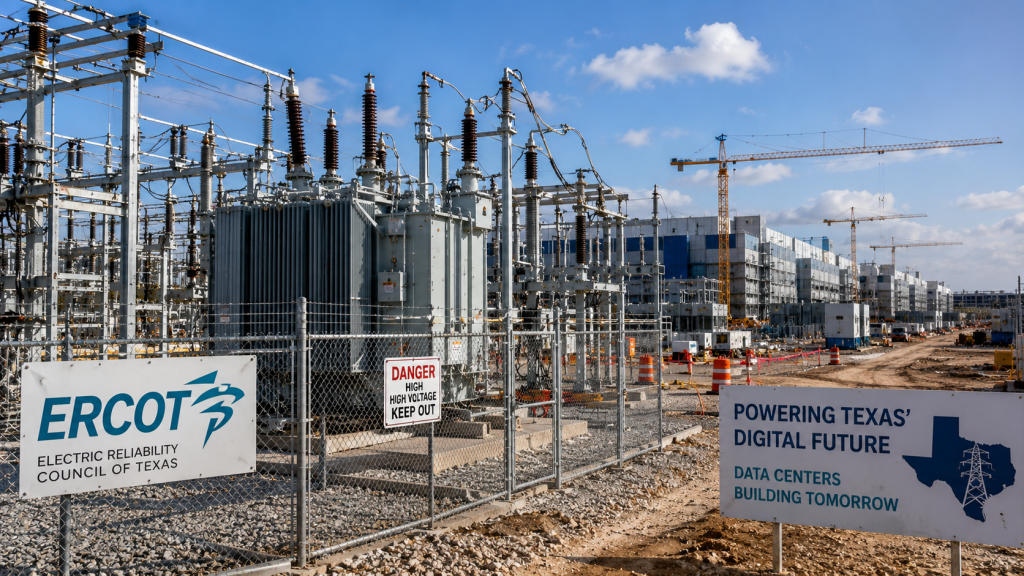
Texas has become one of America’s hottest construction markets for data centers.
Now the state has hit the brakes.
On August 3, 2026, Texas Gov. Greg Abbott directed the Public Utility Commission of Texas and the Electric Reliability Council of Texas, better known as ERCOT, to conduct a comprehensive audit of data centers moving through the state’s grid interconnection process.
Until that verification is completed, affected data center projects cannot move forward through the approval process.
The reason is staggering.
ERCOT is dealing with more than 474 gigawatts of proposed electricity demand from projects seeking connections to the Texas grid. Abbott said approximately 90% of those requests are associated with data centers.
For electrical contractors, estimators and project managers, the story is much bigger than a temporary pause.
Texas is demonstrating what may become one of the defining problems of the AI construction boom:
Developers can build data centers faster than utilities can build the electrical infrastructure required to power them.
474 Gigawatts Is an Extraordinary Number
It is difficult to understand the scale of 474 GW without putting it into perspective.
One gigawatt equals 1,000 megawatts.
So 474 GW equals:
474,000 megawatts.
ERCOT’s existing record peak electricity demand is only a fraction of that amount. Abbott’s office said the interconnection requests represent more than five times the Texas grid’s record peak electricity demand.
Nobody expects every proposed project in the queue to actually be built.
Some proposals are speculative. Others may be duplicates. Some developers may abandon projects because of financing, permitting, power availability or other problems.
But even after accounting for projects that will never reach construction, the amount of proposed electrical load is extraordinary.
The Texas Tribune reported that more than 1,800 individual projects have entered the large-load queue in recent years, with roughly 90% involving data centers.
The number of requests became so large that Texas had to rethink how it studies major electrical loads.
Texas Created a New Process for Massive Electrical Loads
Before the current wave of data center development, utilities could generally study major load additions individually.
That approach becomes difficult when hundreds of enormous projects arrive simultaneously.
ERCOT and the Public Utility Commission responded by developing a process known as Batch Zero.
Instead of studying qualifying large loads one at a time, ERCOT can evaluate them together.
The PUCT approved the Batch Zero process in June 2026 for large electricity users of 75 MW and greater.
The objective is to determine how many large projects the grid can reliably support, where those projects can connect and what transmission upgrades will be necessary.
That last part should be especially interesting to electrical contractors.
Data centers don’t simply require electrical service.
They can require entirely new electrical infrastructure.
A Data Center Can Require the Electrical Infrastructure of a Small City
Traditional commercial construction has trained many electrical contractors to think in terms of amperage.
A building might have a 2,000-amp service.
A larger facility might have a 4,000-amp service.
Industrial facilities can be considerably larger.
But hyperscale data centers change the conversation from amps to megawatts.
Some proposed campuses are measured in hundreds of megawatts.
Others can approach or exceed a gigawatt.
At that scale, the project isn’t simply connecting a building to an existing utility feeder.
The developer may need major utility infrastructure.
That can include:
- New transmission lines
- Transmission line extensions
- New substations
- Substation expansions
- Large power transformers
- Medium-voltage distribution
- High-voltage switchgear
- Protection and relaying
- SCADA and control systems
- Backup generators
- UPS systems
- Battery energy storage
- Busway
- Grounding systems
- Fiber and communications infrastructure
A single data center campus can therefore trigger multiple electrical construction projects.
And Texas potentially has hundreds of these facilities trying to move forward.
The Audit Could Cover 250 to 300 Projects
Abbott’s order initially created some uncertainty about exactly how many projects would be audited.
More details emerged afterward.
ERCOT officials told the Public Utility Commission that approximately 250 to 300 projects would be involved in the immediate verification effort, with most being data centers.
Those projects represent roughly 200 GW of potential future demand.
That alone is more than twice ERCOT’s recent record peak demand.
The audit effectively moves verification to the beginning of the process.
ERCOT wants more confidence that projects entering detailed interconnection studies are legitimate and sufficiently developed.
That is important because an interconnection study requires time and engineering resources.
Studying hundreds of projects that never get built can distort demand forecasts and consume resources that could be devoted to projects with a realistic path to construction.
What Texas Wants to Know About Data Centers
Abbott’s directive goes beyond asking developers how much electricity they want.
Texas officials want considerably more information.
According to the governor’s directive and reporting from the Texas Tribune, developers may be required to provide information concerning:
Electricity consumption.
Onsite power generation.
Water consumption.
Cooling systems.
Tax incentives.
Facility ownership.
Local community impacts.
Measures intended to reduce those impacts.
Projects that fail to comply with applicable requirements can be denied a connection to the Texas grid.
This creates another consideration for electrical contractors pursuing data center work.
The future of these projects may depend increasingly on the developer’s complete infrastructure strategy—not simply construction financing and real estate.
Texas Already Passed Major Large-Load Legislation
The audit isn’t happening in isolation.
Texas lawmakers have already recognized that enormous new electrical loads require new rules.
Senate Bill 6 was developed to address the state’s rapidly changing electricity-demand outlook.
According to the Texas Legislature’s analysis, ERCOT previously estimated 130–150 GW of additional load growth by 2030.
For comparison, ERCOT’s 2024 peak load was approximately 86 GW.
SB 6 focused on four major areas:
Transmission cost allocation.
Grid reliability.
More credible load forecasting.
Requirements for large loads to participate in load shedding during shortages.
That matters to electrical contractors because the relationship between large electrical customers and utilities is changing.
A 500-MW data center cannot necessarily be treated like an ordinary customer.
It can materially affect the regional grid.
The Electrical Load Pipeline Keeps Growing
ERCOT’s own data shows how quickly the large-load market has changed.
A January 2026 ERCOT report showed projected large-load totals rising dramatically through the end of the decade.
The figures included approximately:
26.8 GW in 2026
81.7 GW in 2027
145.7 GW in 2028
188.8 GW in 2029
232.5 GW in 2030
The same ERCOT report showed 92 proposed projects larger than 1,000 MW each, representing more than 140 GW of requested load.
Again, those figures should not be interpreted as a prediction that every project will actually be constructed.
ERCOT’s queue contains projects at different stages of development.
But it illustrates the magnitude of what utilities are being asked to evaluate.
A 1,000-MW project is a one-gigawatt electrical load.
And ERCOT’s data showed dozens of proposed projects at that scale.
Electrical Contractors Should Pay Attention to the 75-MW Threshold
One particularly important number is 75 MW.
ERCOT’s Batch Zero framework covers qualifying large projects of 75 MW and greater.
For perspective, 75 MW represents 75 million watts of electrical demand.
Even the smallest projects entering this process are enormous by normal commercial construction standards.
The electrical equipment packages associated with projects of this size can be substantial.
Medium-voltage switchgear alone can represent major procurement packages.
Then add transformers.
Generators.
UPS systems.
Busway.
Cable.
Conduit.
Controls.
Grounding.
Fire alarm.
Security.
Communications.
Testing.
Commissioning.
The construction opportunities become significant very quickly.
Grid Capacity Could Determine Where Data Centers Get Built
For decades, major construction projects were often driven primarily by land availability, taxes, workforce, transportation and proximity to customers.
Data centers are adding another major factor:
available megawatts.
A developer might find inexpensive land and a business-friendly community.
That doesn’t matter if 300 MW of electricity cannot be delivered to the property.
Electrical infrastructure can therefore become one of the first considerations in site selection.
This could also change land values.
Property near substations and strong transmission infrastructure may become increasingly attractive for industrial and data center development.
Locations with insufficient transmission capacity may struggle to attract projects regardless of other advantages.
Onsite Power Generation Could Become More Important
There is another fascinating development in Texas.
Some data centers are exploring or constructing onsite power generation.
The Texas Tribune noted that facilities using their own generation may be able to reduce their dependence on traditional grid connections.
That could open another major electrical construction market.
A large onsite generation system can require:
- Natural gas generators
- Gas turbines
- Reciprocating engines
- Paralleling switchgear
- Medium-voltage distribution
- Transformers
- Microgrid controls
- Battery storage
- Protection systems
- Synchronization equipment
- Utility interconnection equipment
The data center of the future may increasingly resemble a combination of an industrial facility and a private power plant.
For electrical contractors with generation and medium-voltage expertise, that could create significant opportunities.
Transmission Construction May Be the Bigger Opportunity
The data center itself receives most of the attention.
But contractors should watch what happens outside the fence.
If Texas eventually approves even a fraction of the proposed load, enormous quantities of electrical infrastructure will have to be constructed.
ERCOT’s Batch Zero process is specifically designed to determine available grid capacity and identify the transmission improvements needed to connect large customers.
That could mean:
New transmission corridors.
New substations.
Larger transformers.
Substation expansions.
Reconductor projects.
Additional generation.
Grid-scale battery storage.
Protection and control upgrades.
The supporting infrastructure could become as important as construction of the data centers themselves.
Reliability Remains the Central Issue
Texas has good reason to proceed carefully.
A U.S. Department of Energy reliability assessment found that increasing large-load demand from data centers, Bitcoin mining, industrial facilities and oil-and-gas operations is a significant factor affecting future ERCOT reliability.
The assessment noted more than 20 GW of newly contracted large loads expected by 2028, in addition to other organic demand growth.
Utilities cannot simply connect unlimited new loads and hope enough generation and transmission eventually appears.
The system has to remain reliable throughout the transition.
That means the timing of new loads must be coordinated with the construction of the infrastructure serving them.
This Is a Warning for Electrical Estimators
The Texas situation also carries an important lesson for electrical estimators.
A project appearing on a bid board does not necessarily mean the project has secured adequate utility capacity.
That question should be asked early.
Before investing significant estimating resources into a large data center or industrial project, contractors should understand:
Has utility power been secured?
What is the available capacity?
Has an interconnection agreement been executed?
Is a new utility substation required?
Who pays for transmission improvements?
Who owns the substation?
When will utility power become available?
Is temporary generation required?
Is permanent onsite generation planned?
What electrical equipment has already been released?
Are transformer and switchgear lead times incorporated into the schedule?
Those questions can affect millions of dollars.
The Texas Pause Doesn’t Mean the Data Center Boom Is Over
The August 2026 decision should not be interpreted as Texas abandoning data center development.
Quite the opposite.
Texas is attempting to determine which projects are real, how much power they actually require and how they can be connected without threatening grid reliability.
The scale of the demand forced the state to create a more disciplined process.
ERCOT is aiming to complete the current verification work and continue the Batch Zero process. Current plans call for a comprehensive audit report to be filed with the PUCT in December.
The projects that survive that process could provide a clearer picture of the actual construction pipeline.
For contractors, that could be extremely valuable.
The Data Center Boom Is Becoming a Power Infrastructure Boom
Texas may be giving the rest of the United States an early look at the future.
Artificial intelligence is driving demand for enormous computing facilities.
Those facilities require extraordinary amounts of electricity.
Utilities must build infrastructure to deliver it.
Manufacturers must produce the transformers, switchgear and generators.
Engineers must design the systems.
And electrical contractors must install them.
Texas now has more than 474 GW of proposed load requests in ERCOT’s queue, with data centers accounting for the overwhelming majority, according to state officials.
Not all of those projects will be built.
They don’t need to be.
Even a fraction of that demand would require massive investment in generation, transmission, substations and electrical distribution.
The Texas data center pause therefore isn’t necessarily bad news for electrical construction.
It is evidence that demand has become so large that the electrical grid itself is becoming the limiting factor.
For electrical contractors, the message is clear:
The next phase of the data center boom won’t be determined only by who can build the buildings.
It will be determined by who can deliver the power.