


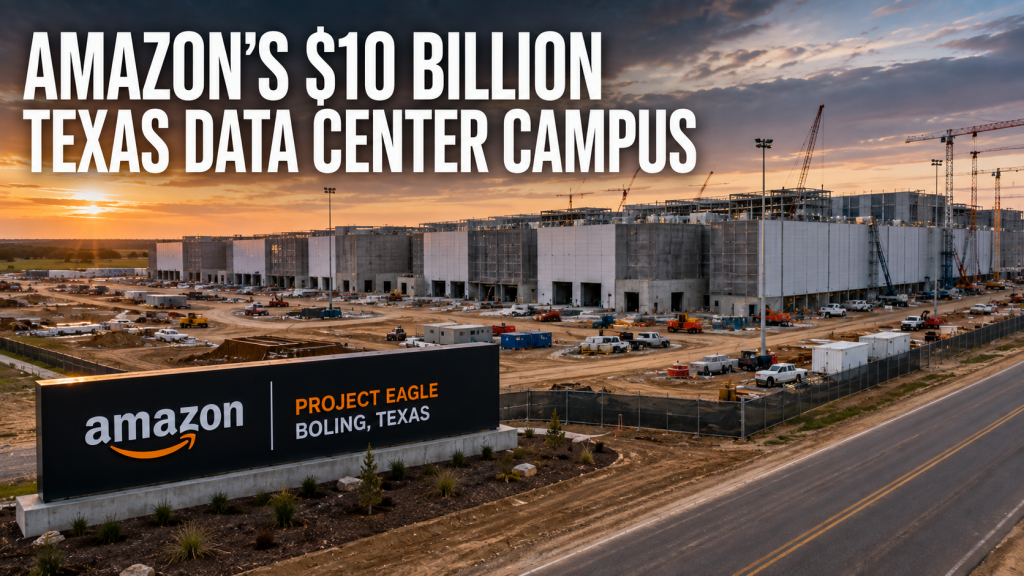
Amazon is preparing another enormous investment in America’s artificial intelligence infrastructure.
This time, the project is taking shape in rural Texas.
Amazon Web Services is planning a massive data center campus near Boling in Wharton County, southwest of Houston. The development, known as Project Eagle, is planned across nearly 3,000 acres and could ultimately represent approximately $10 billion in investment. Public records now identify at least 10 major data center buildings planned for the site.
For electrical contractors, estimators and project managers, the most interesting part of this project isn’t simply its $10 billion price tag.
It is the amount of electrical infrastructure a development of this size could require.
The buildings will need power.
Lots of it.
That means transformers, switchgear, generators, medium-voltage distribution, busway, UPS systems, grounding, controls, communications and potentially major utility infrastructure.
Projects such as this show why the artificial intelligence boom is rapidly becoming an electrical construction boom.
Project Eagle Is Already Taking Shape
Project Eagle isn’t simply a conceptual development on a long-range planning map.
State construction filings provide concrete details about the project.
The Texas Department of Licensing and Regulation identifies Amazon Data Services Inc. as the owner of Project Eagle data center buildings in Boling, Texas.
The first four buildings were registered with the state in June.
Each building was listed at approximately:
189,060 square feet
and
$300 million in estimated construction cost.
That represented approximately 756,000 square feet and $1.2 billion of registered construction from just the first four buildings.
Then the project became much larger.
Six additional data center buildings were registered on August 5.
Buildings E, F, G, H, J and K are also listed at approximately 189,060 square feet and $300 million each.
With those additions, the 10 registered data center buildings represent approximately 1.89 million square feet and $3 billion in estimated construction cost.
And that may still represent only part of the total investment.
The approximately $3 billion figure comes from the construction costs listed in the individual state filings. Those estimates don’t necessarily include the entire cost of developing and equipping the campus.
Reporting on the larger development places total investment at approximately $10 billion.
The Electrical Package Could Be Enormous
A 1.89-million-square-foot commercial project would already attract attention from electrical contractors.
But data centers are different from ordinary commercial buildings.
The power density is dramatically higher.
A warehouse may have relatively modest electrical demand per square foot.
An office building may have a much larger electrical system.
A hospital requires sophisticated emergency power.
A data center combines enormous electrical demand with extraordinary reliability requirements.
That changes the electrical scope completely.
A campus such as Project Eagle could require extensive systems involving:
- Utility substations
- Medium-voltage switchgear
- Power transformers
- Backup generators
- Paralleling switchgear
- Automatic transfer equipment
- UPS systems
- Battery systems
- Power distribution units
- Busway
- Large feeder installations
- Cable tray
- Grounding and bonding
- Lightning protection
- Controls
- Monitoring systems
- Fire alarm
- Security
- Communications
- Testing and commissioning
And that is before considering the utility infrastructure required to deliver power to the property.
For an electrical estimator, a data center campus is essentially a collection of major electrical projects built together.
How Much Power Will Project Eagle Need?
That remains one of the biggest unanswered questions.
Public reporting indicates Amazon has not disclosed the campus’s ultimate electricity demand.
However, Amazon’s application to ERCOT places the project within the state’s large-load process, indicating a peak load of at least 75 MW. The actual completed campus could require considerably more power, but a final figure has not been publicly confirmed.
That distinction is important.
Electrical contractors should be cautious about assuming an eventual megawatt requirement that hasn’t been released.
What is clear is that Texas is experiencing extraordinary demand from proposed data centers.
That has made utility interconnection one of the most important issues facing new developments.
The question is no longer simply:
Can we build the data center?
Increasingly, the question is:
Can we power it?
Amazon Says Data Centers Should Pay Their Own Infrastructure Costs
The debate over who pays for the infrastructure serving massive data centers is becoming increasingly important.
Amazon addressed that issue directly this month.
The company said it agrees that data centers should fully pay for their own energy infrastructure costs rather than shifting those costs onto residential electricity customers.
That policy could have enormous implications for construction.
If developers are responsible for infrastructure required specifically to serve their facilities, the project scope can expand beyond the data center property itself.
New electrical infrastructure might include utility interconnections, transmission improvements, substations, transformers and related equipment.
For electrical contractors, that creates two separate opportunities.
There is the electrical construction inside the data center campus.
And there is the electrical construction required to bring power to the campus.
In some cases, the second opportunity could become nearly as important as the first.
Construction Is Moving Quickly
The state filings also demonstrate how aggressively Amazon is moving.
Project Eagle Building A was registered with an estimated construction start date of August 1, 2026, with completion listed for January 1, 2027.
Several of the later buildings are listed with construction beginning September 1, 2026 and completion scheduled for September 1, 2027.
Schedules can change.
Large projects frequently do.
But the filings demonstrate the speed developers are seeking.
That creates another major issue for electrical contractors:
procurement.
A contractor may be able to mobilize electricians quickly.
Manufacturers cannot necessarily produce large transformers, switchgear and generators just as quickly.
Long-Lead Equipment Could Determine the Schedule
Electrical equipment has become one of the biggest schedule risks on major construction projects.
Data centers make that challenge even more serious.
Consider a project requiring multiple medium-voltage switchgear lineups, transformers, generators and UPS systems.
Those components can’t simply be purchased at a local supply house.
They must be engineered.
Approved.
Manufactured.
Tested.
Shipped.
Installed.
Commissioned.
The electrical contractor may therefore need to begin procurement long before large portions of the building are ready.
That changes how projects are estimated and managed.
The estimator isn’t simply calculating material and labor.
The estimating team may also need to identify:
Manufacturer lead times.
Escalation exposure.
Approved equivalents.
Release dates.
Factory testing requirements.
Shipping requirements.
Temporary power needs.
Storage requirements.
Commissioning schedules.
A missed equipment release date can potentially affect an entire data center schedule.
Repeatable Buildings Create Prefabrication Opportunities
Project Eagle provides another clue about how data center construction is evolving.
The registered buildings are remarkably similar.
Multiple buildings are listed at approximately 189,060 square feet with estimated construction costs of $300 million each.
That repetition creates an opportunity for standardization.
Once an electrical contractor successfully builds the first building, many processes may potentially be repeated.
Conduit racks can be prefabricated.
Equipment layouts can be standardized.
Cable assemblies can be prepared.
Electrical rooms can potentially be modularized.
Material packages can be organized by area.
Labor productivity data from the first building can improve estimates for later buildings.
The contractor begins moving away from treating every building as a completely unique construction project.
Instead, the campus becomes a repeatable production process.
That can produce major productivity improvements.
The First 10 Buildings Alone Represent $3 Billion in Registered Construction
The numbers deserve another look.
Ten buildings.
Approximately 189,060 square feet each.
Approximately $300 million in registered construction cost each.
That produces roughly:
1,890,600 square feet
and
$3 billion in listed construction costs.
The total proposed campus investment has been reported at approximately $10 billion.
Those figures help explain why contractors are paying so much attention to data centers.
Even if electrical work represents only a portion of total construction spending, the potential electrical packages on developments of this size can be enormous.
Thousands of Construction Jobs Could Be Created
Project Eagle is also expected to become an important source of construction employment.
Reporting on the development indicates Amazon expects the campus to create thousands of temporary construction jobs, with at least 150 permanent positions expected by 2027 and potentially hundreds more as the campus grows.
That construction workforce will include far more than electricians.
But electrical construction is one of the most labor-intensive and technically demanding components of a hyperscale data center.
Projects require electricians, foremen, general foremen, superintendents, project managers, estimators, BIM specialists, engineers, controls technicians, testing technicians and commissioning specialists.
And when multiple large campuses are constructed simultaneously, those workers become increasingly difficult to find.
Rural Data Center Construction Creates a Labor Challenge
Boling is a small community.
That matters.
Building a huge data center near a major metropolitan area is one thing.
Building a multi-billion-dollar campus in a rural area creates different logistical challenges.
Contractors may need to recruit workers from a much larger region.
Some workers may require significant travel.
Temporary housing can become an issue.
Per diem can affect labor costs.
Transportation can affect productivity.
Supervision becomes critical.
Material staging requires planning.
Local subcontractor capacity may be limited.
For estimators, these conditions must be reflected in the bid.
Using standard labor assumptions from a project 20 minutes from a major city could produce an unrealistic estimate for a remote project requiring hundreds of electricians.
Amazon’s Texas Expansion Goes Beyond Project Eagle
Project Eagle is also not Amazon’s only Texas data center initiative.
AWS has been pursuing other large campuses across the state.
Recent filings and land acquisitions have connected the company with projects or potential projects in Bastrop County, Pecos County and other Texas markets.
Amazon announced this month that its planned Pecos County data center campus will initially use new onsite generation rather than relying entirely on immediate grid-connected service.
The company says the campus is designed to transition toward grid service as interconnection timelines allow. Amazon is also exploring solar generation and battery storage at the site.
That development should get the attention of electrical contractors.
A data center with its own large-scale generation system creates another layer of electrical work.
Now the project isn’t simply a data center.
It is also a power plant.
Onsite Generation Could Create a New Electrical Market
If grid interconnection delays continue, more developers may consider producing some or all of their electricity onsite.
That could require:
- Natural gas generation
- Gas turbines
- Reciprocating generators
- Generator paralleling
- Medium-voltage switchgear
- Microgrid controls
- Battery energy storage
- Transformers
- Protection systems
- Synchronization equipment
- Utility interconnection equipment
This could create an entirely new category of data center electrical construction.
Instead of the utility providing all primary power and generators providing emergency backup, future campuses may use a combination of grid power, onsite generation and energy storage.
Electrical systems become much more sophisticated.
So do the opportunities.
Water Is Becoming Part of Data Center Planning Too
Electricity isn’t the only infrastructure issue facing massive computing facilities.
Cooling requires careful water planning.
For Project Eagle, public reporting indicates the campus could use as much as approximately 163 million gallons of water annually, although plans call for surface water rather than groundwater. Amazon is also working with Kilimo on agricultural water conservation efforts in the region.
Amazon separately says it is working toward becoming water positive by 2030 and has more than 50 projects expected to return 5.8 billion gallons annually to communities.
For electrical contractors, water may seem unrelated.
It isn’t.
Cooling design affects electrical load.
Mechanical systems affect electrical distribution.
Pump systems require power.
Cooling technologies influence generator sizing, switchgear loading and overall facility demand.
In a data center, electrical and mechanical design are deeply connected.
Electrical Estimators Should Study These Projects Now
Even contractors that aren’t currently bidding hyperscale data centers should study projects such as Project Eagle.
They reveal where electrical construction is heading.
Estimators should become increasingly comfortable with:
Medium-voltage distribution.
Large generator systems.
UPS systems.
Busway.
Large transformers.
Paralleling equipment.
Electrical equipment procurement.
Mission-critical redundancy.
BIM coordination.
Prefabrication.
Testing.
Commissioning.
High-voltage utility coordination.
These skills won’t be limited to data centers.
Advanced manufacturing, semiconductor plants, battery factories and other major industrial projects require many of the same capabilities.
Amazon Is Making a Massive Bet on AI Infrastructure
Project Eagle also has to be viewed within Amazon’s broader capital spending.
Amazon CEO Andy Jassy has said the company expects to invest approximately $200 billion in capital expenditures during 2026, much of it connected to AWS infrastructure and artificial intelligence opportunities.
Jassy said Amazon already has customer commitments supporting a substantial portion of expected AWS capital spending.
Amazon has also announced up to $50 billion in additional investment to expand AI and high-performance computing infrastructure for U.S. government customers, including nearly 1.3 GW of additional compute capacity.
Project Eagle is therefore part of a much larger infrastructure buildout.
And Amazon is only one company.
AI Is Becoming a Physical Construction Industry
Artificial intelligence often sounds like an entirely digital business.
It isn’t.
AI requires physical infrastructure on an enormous scale.
It requires land.
Buildings.
Servers.
Cooling.
Generators.
Transformers.
Switchgear.
Substations.
Transmission.
And electricians.
Project Eagle makes that reality difficult to ignore.
At least 10 large data center buildings are now registered in Texas, representing approximately 1.89 million square feet and $3 billion in listed construction costs, while the broader campus has been reported as an investment of approximately $10 billion.
For electrical contractors, this is exactly the type of project worth watching.
Not because every contractor will bid Amazon’s next hyperscale campus.
Most won’t.
But projects like this show where billions of dollars in construction spending are heading.
Data centers need extraordinary amounts of electrical infrastructure.
The grid needs to expand around them.
Manufacturers need to produce the equipment.
Electrical contractors need to install it.
And skilled electricians need to make all of it work.
The AI revolution may have started with software.
But increasingly, it is being built by the electrical construction industry.