Your Jobs. Your Industry. Your Recruiting Platform.
Finding qualified electrical construction professionals isn’t easy.
You already know that.
Experienced estimators, project managers, superintendents, foremen, electricians, preconstruction professionals, and executives are in demand. The best candidates often aren’t actively searching traditional job boards.
They’re working.
They’re estimating projects.
They’re running jobs.
They’re managing crews.
They’re building careers.
And reaching those passive candidates can be one of the hardest and most expensive parts of recruiting.
iBidElectric is different.
We’re not trying to be another general-purpose job board.
iBidElectric is built around electrical construction.
That means your job openings are being presented in an environment created specifically for the industry you need to recruit from.
Up to 10 Active Jobs for $995/Month
One simple monthly subscription.
$995 Per Month
Post Up to 10 Active Jobs at One Time
No need to purchase another package every time you need to recruit for another position.
Your subscription allows your company to maintain up to 10 active job postings simultaneously on iBidElectric.
Reach your 10-job limit?
Simply delete an old, filled, canceled, or no-longer-needed position and post your next opening.
Your 10 job slots are reusable.
Fill a Project Manager position?
Delete it and post an Estimator opening.
Hire your Superintendent?
Remove that posting and start recruiting a General Foreman.
Close an Electrician opening?
Use the available slot for your next position.
As long as your subscription remains active, you can continually manage and replace your jobs while maintaining up to 10 active postings at a time.
One Subscription. An Ongoing Recruiting Resource.
Traditional job posting packages can become expensive very quickly.
Need to advertise another opening?
Buy another posting.
Need another estimator?
Buy another posting.
Need three project managers in different markets?
Buy more postings.
Need to replace someone six weeks later?
Start paying again.
With iBidElectric, your subscription becomes an ongoing recruiting resource for your company.
For $995 per month, you can maintain up to 10 active positions and continually replace jobs as your hiring needs change.
At the full 10-job capacity, that’s just:
$99.50 Per Active Job Per Month
For companies that recruit throughout the year, that can make budgeting for recruiting considerably easier.
Recruiting Is Expensive
Anyone who has hired experienced construction professionals knows how quickly recruiting expenses can grow.
There are job-board fees.
Recruiter fees.
Agency fees.
Advertising expenses.
Internal recruiting costs.
Management time.
Interview time.
And then there’s the cost of leaving an important position unfilled.
An open estimator position can affect how many projects you can pursue.
An open project manager position can affect how much work your company can comfortably manage.
A superintendent shortage can affect field operations.
And failing to recruit enough skilled field personnel can affect your ability to staff the projects you’ve already won.
The cost isn’t limited to the recruiting fee.
The real cost can be the opportunities your company misses while trying to find the right person.
The People You Want May Not Be Looking for a Job
This is one of the biggest challenges in electrical construction recruiting.
The strongest candidate for your position may never visit a traditional job board.
They may already have a job.
They may be reasonably happy.
They may not have updated a résumé in years.
But that doesn’t necessarily mean they wouldn’t consider the right opportunity.
A better company.
A larger role.
More responsibility.
A shorter commute.
A stronger compensation package.
A move into estimating or project management.
A chance to become a superintendent.
A better long-term career path.
These are passive candidates.
They’re difficult to reach because they’re not necessarily searching for you.
That’s why placing your opportunities inside an electrical-construction-focused platform matters.
Stop Recruiting Everyone. Start Recruiting Electrical Construction.
There are plenty of places to post a job.
But electrical construction isn’t just another employment category.
It’s an industry with its own language, career paths, skills, responsibilities, and culture.
We understand the difference between:
- An estimator and a senior estimator
- A project manager and a project executive
- A foreman and a general foreman
- A superintendent and a general superintendent
- Service work and large commercial construction
- Design-build and plan-and-spec work
- Preconstruction and operations
- BIM/VDC and traditional field coordination
- Commercial, industrial, institutional, healthcare, mission-critical, and other electrical markets
Electrical construction isn’t one category on iBidElectric. It’s what iBidElectric is about.
Recruit Across Your Entire Electrical Construction Organization
Your 10 active postings can be used for virtually any position your electrical construction company needs to fill, including:
- Electrical Estimators
- Senior Electrical Estimators
- Chief Estimators
- Preconstruction Managers
- Directors of Preconstruction
- Electrical Project Managers
- Senior Project Managers
- Project Executives
- Assistant Project Managers
- Electrical Superintendents
- General Superintendents
- General Foremen
- Electrical Foremen
- Journeyman Electricians
- Apprentices
- Service Managers
- Service Electricians
- BIM/VDC Professionals
- BIM Managers
- CAD/Revit Professionals
- Purchasing Professionals
- Safety Managers
- Operations Managers
- Branch Managers
- Business Development Professionals
- Electrical Construction Executives
Whether you’re recruiting one estimator or building an entire project team, your subscription gives you room to keep multiple opportunities active.
Built for Electrical Contractors
This isn’t recruiting software designed by people who simply added “electrical” to a list of industries.
iBidElectric was built from decades of commercial electrical construction experience.
We understand what electrical contractors do.
We understand estimating.
We understand preconstruction.
We understand project management.
We understand field operations.
And we understand just how difficult it can be to find experienced electrical construction professionals.
That industry focus is at the center of the iBidElectric recruiting platform.
Ideal for Contractors With Ongoing Hiring Needs
The $995 monthly employer subscription is especially valuable for:
- Commercial electrical contractors
- Industrial electrical contractors
- Electrical service contractors
- National electrical contractors
- Regional electrical contractors
- Specialty electrical contractors
- Low-voltage and technology contractors
- Electrical engineering and design firms
- Electrical construction divisions
- Contractors expanding into new markets
- Companies staffing major projects
- Contractors building their estimating and preconstruction departments
If your company recruits throughout the year, you shouldn’t have to evaluate the cost of buying another individual posting every time someone resigns, retires, gets promoted, or you win another project.
Keep your recruiting pipeline open.
Hiring in Multiple Markets?
Your 10 active positions don’t have to be for the same office, city, or department.
A growing electrical contractor could advertise:
Electrical Estimator — Cleveland
Senior Project Manager — Columbus
Electrical Superintendent — Cincinnati
Project Executive — Nashville
General Foreman — Charlotte
BIM/VDC Manager — Dallas
Service Manager — Atlanta
Electrical Estimator — Tampa
Project Manager — Phoenix
Electrical Superintendent — Denver
That’s ten different recruiting needs under one $995 monthly subscription.
When one position is filled, delete it and use that slot for your next opening.
Your Recruiting Needs Don’t Stop After 30 Days
Electrical contractors don’t hire according to job-board posting cycles.
You hire when you:
Win work.
Enter a new market.
Open an office.
Replace an employee.
Promote someone.
Expand a department.
Build a new division.
Increase your backlog.
Need additional field supervision.
Find an exceptional person you don’t want your competition to hire first.
That’s why the iBidElectric employer subscription is designed around active jobs rather than individual posting purchases.
Your recruiting needs change.
Your job postings can change with them.
What Your $995 Monthly Subscription Includes
- Up to 10 active job postings at one time
- Reusable job posting slots
- Delete filled or outdated jobs and replace them
- Post positions throughout electrical construction
- Recruit for multiple offices and geographic markets
- Recruit field, office, management, estimating, and executive positions
- Maintain an ongoing recruiting presence
- One predictable monthly recruiting expense
- No need to purchase another posting every time a position changes
- Access to an electrical-construction-focused platform
- Cancel anytime
Consider the Cost of Just One Successful Hire
The value of recruiting isn’t measured by how many people see an advertisement.
It’s measured by whether the right person sees it.
What is a strong electrical estimator worth to your company?
What is an experienced project manager worth?
What is a superintendent capable of successfully delivering a major project worth?
What does it cost when you can’t find that person?
One successful hire can potentially influence millions of dollars in estimates, projects, customer relationships, field productivity, and future opportunities during that employee’s career with your company.
Against that potential value, $995 per month gives your organization an ongoing recruiting presence with up to 10 active opportunities.
Build a Recruiting Pipeline Before You Need It
The worst time to begin recruiting is often when you desperately need someone.
A project starts in three weeks.
An estimator unexpectedly leaves.
A project manager resigns.
Your backlog jumps.
You win a major project.
Suddenly, finding someone becomes urgent.
Maintaining your jobs on iBidElectric allows your company to take a longer-term approach.
Recruit continuously.
Keep your company visible.
Let experienced electrical construction professionals discover your opportunities.
Build awareness before the hiring need becomes an emergency.
$995/Month. Up to 10 Active Jobs.
One Employer Subscription.
Ten Active Opportunities.
Reusable Job Slots.
One Industry: Electrical Construction.
Post your openings.
Reach electrical construction professionals.
Fill a position.
Delete the old posting.
Post your next opportunity.
And keep recruiting.
Employer Recruiting Membership — $995/Month
Post up to 10 active jobs at one time.
Replace filled or outdated positions whenever you need to.
Cancel anytime.
Put Your Opportunities in Front of the Electrical Construction Industry.
GET STARTED
[ibe_saved_articles]
Your Jobs. Your Industry. Your Recruiting Platform. Finding qualified electrical construction professionals isn't easy. You already know that. Experienced estimators, project managers, superintendents, foremen, electricians, preconstruction professionals, and...
Listen Now
Artificial intelligence may be one of the biggest technology stories in the world, but some of its biggest beneficiaries could be electricians. The massive expansion of AI data...
Listen Now
Amazon is preparing another enormous investment in America's artificial intelligence infrastructure. This time, the project is taking shape in rural Texas. Amazon Web Services is planning a massive...
Listen Now
Texas has become one of America's hottest construction markets for data centers. Now the state has hit the brakes. On August 3, 2026, Texas Gov. Greg Abbott directed...
Listen Now
America has a growing electricity problem. The country needs more power. But generating more electricity is only part of the challenge. That electricity also has to get where...
Listen Now
Artificial intelligence is creating something much larger than a technology boom. It is creating an electrical construction boom. Across the United States, billions of dollars are flowing into...
Listen Now
Artificial intelligence may be one of the biggest technology stories in the world, but some of its biggest beneficiaries could be electricians.
The massive expansion of AI data centers across the United States is creating extraordinary demand for skilled construction workers who can actually build the infrastructure.
Electricians are near the top of that list.
Recent hiring data shows data-center-related job postings have more than doubled in two years, even while overall U.S. job postings declined. Installation and maintenance positions associated with data centers are also offering meaningful wage premiums compared with similar work outside the sector.
Some electricians working on large data center projects are earning six-figure incomes when overtime, travel and other compensation are included. Current job listings also show hourly rates of $50, $60 and even more for licensed electricians on major data center projects.
For electrical contractors, however, the story has two sides.
Data centers represent an enormous construction opportunity.
But they are also creating fierce competition for the electricians needed to build everything else.
AI Can’t Build a Data Center Without Electricians
Artificial intelligence sounds like a software business.
Behind every AI application is an enormous amount of physical infrastructure.
AI models run on powerful processors installed inside data centers. Those processors consume large quantities of electricity and produce enormous amounts of heat.
Before a server can perform a single AI calculation, someone must build the electrical system supporting it.
That can require:
- Utility substations
- Power transformers
- Medium-voltage switchgear
- Generators
- Paralleling switchgear
- UPS systems
- Battery systems
- Busway
- Distribution equipment
- Feeders
- Cable tray
- Grounding
- Controls
- Fire alarm systems
- Communications systems
- Testing and commissioning
Those systems don’t install themselves.
They require electricians, electrical foremen, superintendents, engineers, project managers, estimators, controls technicians and commissioning specialists.
Associated General Contractors of America notes that data centers require specialized electrical systems, backup generation, cooling equipment, fiber connectivity, security systems and extensive utility infrastructure. The projects create demand across a wide range of skilled trades, particularly electricians.
That demand is beginning to change the construction labor market.
Data Center Job Postings Have More Than Doubled
One of the strongest indications comes from job-posting data.
Recent Indeed research reported by Business Insider found that postings for data-center-related positions have more than doubled over the past two years.
Approximately six of every 1,000 U.S. job postings are now connected to data centers.
In 2023, the figure was roughly two per 1,000.
That means the share has approximately tripled.
More important for electrical contractors, this isn’t primarily a story about software engineers.
About one-quarter of the positions are in installation and maintenance.
Those workers are earning more, too.
According to the Indeed analysis, installation and maintenance positions associated with data centers pay approximately $10 per hour more than comparable positions outside the data center industry.
That creates a powerful incentive for skilled workers to move toward data center construction.
Six-Figure Electrician Jobs Are Becoming Real
The idea of a six-figure electrician isn’t new.
Experienced electricians working substantial overtime, managing crews, traveling or working specialized industrial projects have earned six figures for years.
What is changing is the scale of the opportunity.
The AI infrastructure boom is creating more projects with the budgets and urgency required to pay premiums for skilled workers.
Nvidia CEO Jensen Huang has repeatedly pointed toward skilled trades as major beneficiaries of AI infrastructure spending. Recent reporting highlighted electricians, HVAC technicians and other construction workers as occupations where six-figure compensation is increasingly possible as companies compete for scarce labor.
Current data center job listings illustrate what is happening.
Recent listings include offers such as:
$60 per hour plus $150 per day in per diem in Iowa.
$64 per hour plus $175 per day in per diem for a journeyman electrician in Des Moines.
$50 per hour plus $145 per day in per diem for a North Dakota licensed journeyman working approximately 55 hours per week.
Another Texas listing advertised $45 per hour plus $178 per day in per diem with a 60-hour workweek.
Those aren’t national averages.
They are examples of current project-specific offers and shouldn’t be interpreted as what every data center electrician earns.
But they demonstrate how aggressive compensation can become when contractors urgently need qualified electricians.
Do the Math on a $60-Per-Hour Electrician
Consider what a large project’s labor demands can mean for individual earnings.
An electrician making $60 per hour earns:
$2,400 for a standard 40-hour week before taxes and deductions.
That equals approximately $124,800 annually if that straight-time rate continued for 52 weeks.
Now add overtime.
Many large industrial and data center projects operate extended schedules.
A worker putting in 58 or 60 hours per week could earn substantially more depending on the project’s overtime rules.
Then add per diem.
A worker receiving $150 per day for seven days receives another $1,050 per week to offset eligible travel and living expenses, subject to the arrangement and applicable tax rules.
This helps explain how total compensation on major projects can reach levels that would have seemed unusual for many construction positions not long ago.
But contractors should recognize what those numbers mean for them.
Labor is becoming expensive.
Data Centers Are Competing for the Same Electricians Contractors Already Need
This may be the biggest issue for electrical contractors.
The data center industry isn’t creating electricians overnight.
It is initially recruiting many of them from the existing electrical workforce.
That electrician may currently be building an office.
Hospital.
School.
Warehouse.
Manufacturing plant.
Apartment complex.
Distribution center.
Or another commercial project.
When a data center contractor offers significantly higher wages, substantial overtime and per diem, that worker suddenly has a powerful reason to leave.
This creates labor pressure throughout the electrical construction market.
A commercial contractor may not be competing against another local electrical contractor anymore.
It could be competing against a multi-billion-dollar hyperscale data center project hundreds of miles away.
The Electrician Shortage Already Existed
The data center boom didn’t create America’s electrician shortage.
It is making the existing problem harder.
AGC has repeatedly warned that contractors are struggling to find workers with the specialized skills needed to construct data centers, power projects and other advanced infrastructure.
The organization has specifically called for increased investment in career and technical education and workforce training to expand the supply of electricians and other skilled workers.
The problem can’t be solved quickly.
A qualified journeyman electrician isn’t created through a six-week training program.
Developing skilled electricians takes years.
They must learn electrical theory.
Code.
Blueprint reading.
Installation techniques.
Troubleshooting.
Safety.
Equipment.
Controls.
Testing.
And, increasingly, sophisticated medium-voltage and mission-critical systems.
That experience becomes even more valuable on a data center project.
Data Centers Need More Than Ordinary Commercial Electrical Experience
Not every electrician is immediately ready for mission-critical construction.
The electrical systems are sophisticated.
Reliability requirements are extremely high.
Shutdowns can have enormous financial consequences.
Data center electrical workers may encounter equipment and systems such as:
Medium-voltage switchgear.
Large transformers.
Paralleling generators.
UPS systems.
Static transfer switches.
Busway.
Battery systems.
Redundant distribution.
Power monitoring.
Protection systems.
Controls.
Commissioning.
A commercial electrician with strong fundamentals can learn these systems.
But training takes time.
That creates another shortage inside the shortage.
The industry doesn’t simply need electricians.
It needs electricians with mission-critical experience.
Contractors May Need to Rethink Their Labor Rates
Electrical estimators should watch this trend closely.
Labor rates based on historical averages can quickly become dangerous.
Suppose an estimator carries a journeyman labor rate based on what the company paid 12 months ago.
Then a major data center project starts 50 miles away.
Suddenly competing contractors begin hiring.
Wages increase.
Workers leave.
Overtime becomes necessary.
Per diem becomes necessary.
Retention bonuses appear.
The estimate may still contain the correct number of labor hours.
But the cost per labor hour is wrong.
On a labor-intensive electrical project, that can destroy the job’s profit.
Estimators should therefore monitor actual local labor-market conditions, particularly in areas experiencing rapid data center development.
Productivity Could Become Just as Important as Wage Rates
Higher wages don’t automatically mean electrical contractors cannot make money.
But they make productivity more important.
Imagine two contractors installing identical electrical systems.
Contractor A requires 100,000 labor hours.
Contractor B uses prefabrication, BIM coordination, material planning and better field management to complete the same work in 85,000 hours.
At $40 per hour, the 15,000-hour difference matters.
At $60 per hour plus payroll burden and overtime, it matters much more.
High labor costs reward productive contractors.
That is why data center construction is likely to accelerate investment in:
Prefabrication.
BIM.
Modular construction.
Material logistics.
Digital field management.
Labor tracking.
Detailed production planning.
The cheapest electrician isn’t necessarily the competitive advantage.
The most productive electrical workforce may be.
Major Investors Are Already Trying to Solve the Labor Problem
The labor shortage has become important enough that major infrastructure investors are taking action.
BlackRock and partners involved in AI infrastructure investment recently reached an agreement with North America’s Building Trades Unions, which represents more than 3 million skilled construction workers in the United States and Canada.
The arrangement is intended to improve workforce planning for upcoming infrastructure projects and strengthen apprenticeship, training and recruitment pipelines.
That is significant.
When investors responsible for financing enormous infrastructure projects begin worrying about whether enough electricians will be available, labor has become more than a contractor problem.
It has become a project-development problem.
A developer can have land.
Financing.
Engineering.
Equipment.
Utility power.
Permits.
But if the contractor cannot assemble the workforce, the data center still doesn’t get built.
Data Center Construction Is Supporting Construction Employment
The effects are already showing up in broader employment data.
Construction added approximately 22,000 jobs in July 2026, with gains concentrated in nonresidential construction and specialty trade contracting.
Reporting on the July employment data identified the data center construction boom as an important factor supporting hiring even as other areas of construction softened.
That provides another indication of the unusual nature of the current market.
Some construction sectors may slow.
AI infrastructure can continue pulling workers toward data centers.
For electrical contractors serving multiple markets, that can create an unusual situation.
The company’s project backlog might soften while its labor costs continue increasing because another sector is competing for the same electricians.
Manufacturers Are Hiring Too
Construction contractors aren’t the only companies competing for workers.
The entire electrical supply chain is expanding.
Reuters reported this month that the U.S. data center boom is benefiting manufacturers of generators, electrical equipment, cables, cooling equipment and other products.
Generac alone is investing approximately $250 million in manufacturing capacity for larger data center generators and expects to add about 1,000 workers. The company reported a data center backlog of approximately $1.6 billion.
Other manufacturers are expanding as well.
That means skilled electrical and technical workers have even more options.
They can work for contractors.
Manufacturers.
Utilities.
Commissioning firms.
Maintenance companies.
Data center operators.
Competition for electrical talent is spreading across the entire industry.
Electrical Contractors Need a Workforce Strategy
For contractors, simply posting a job opening may no longer be enough.
Companies need a workforce strategy.
That can include:
Apprenticeship programs.
Build electricians instead of relying entirely on hiring them from competitors.
Training.
Give existing electricians opportunities to learn medium-voltage systems, controls, UPS equipment and mission-critical construction.
Career paths.
Show apprentices how they can become journeymen, foremen, general foremen, superintendents and project managers.
Retention.
Experienced electricians are increasingly valuable. Keeping them may be less expensive than replacing them.
Prefabrication.
Move appropriate work into controlled environments where productivity can improve.
Technology.
Use BIM, digital drawings, material tracking and labor reporting to help electricians spend more time installing and less time searching for information.
Estimating discipline.
Carry realistic wage escalation, overtime, supervision, travel and productivity assumptions.
Labor strategy is becoming business strategy.
A Huge Opportunity for the Next Generation of Electricians
There is also a positive side to this story.
The electrical industry needs young people.
For decades, students were often told that a four-year college degree was the primary path toward a successful career.
The data center boom is providing another example of why skilled trades can offer an excellent alternative.
An electrical apprentice can earn money while learning.
The apprentice gains a skill that cannot easily be outsourced.
After becoming a journeyman, multiple career paths become available.
A journeyman can become a foreman.
A foreman can become a superintendent.
Field experience can lead to estimating.
Project management.
Safety.
BIM.
Commissioning.
Service.
Sales.
Or eventually owning an electrical contracting company.
And now AI infrastructure is increasing demand for those skills.
AI May Create More Electrical Jobs Than People Expected
There is an irony in the artificial intelligence revolution.
Much of the public discussion focuses on jobs AI could eliminate.
But AI itself requires enormous physical infrastructure.
And building that infrastructure requires people.
Data-center-related job postings have more than doubled in two years. Installation and maintenance workers supporting data centers are commanding wage premiums. Current project listings show licensed electricians being offered $50 to $60 per hour or more in some markets, often with overtime and per diem.
Meanwhile, contractors and major infrastructure investors are actively trying to expand the skilled-trades workforce because they are concerned there won’t be enough qualified people to build everything already planned.
For electrical contractors, this creates both opportunity and risk.
There may be more electrical work than the industry has seen in years.
But winning the project won’t matter if you cannot staff it.
The next competitive advantage in electrical construction may therefore be something much harder to buy than switchgear or transformers.
Electricians.
AI may be powered by some of the most advanced technology ever developed.
But before any of that technology works, somebody still has to wire it.
Amazon is preparing another enormous investment in America’s artificial intelligence infrastructure.
This time, the project is taking shape in rural Texas.
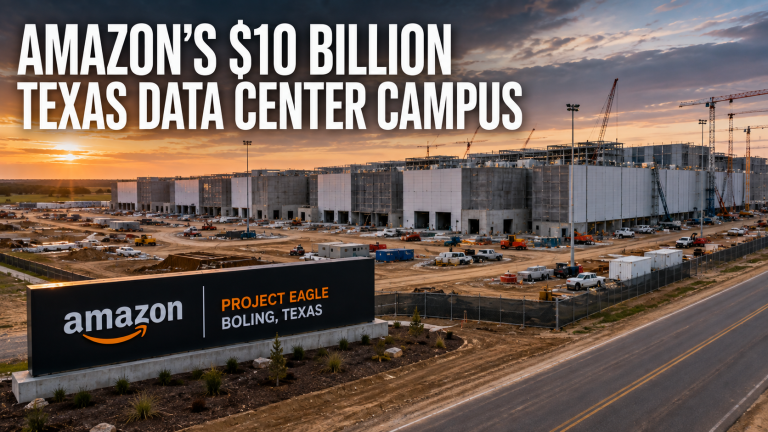
Amazon Web Services is planning a massive data center campus near Boling in Wharton County, southwest of Houston. The development, known as Project Eagle, is planned across nearly 3,000 acres and could ultimately represent approximately $10 billion in investment. Public records now identify at least 10 major data center buildings planned for the site.
For electrical contractors, estimators and project managers, the most interesting part of this project isn’t simply its $10 billion price tag.
It is the amount of electrical infrastructure a development of this size could require.
The buildings will need power.
Lots of it.
That means transformers, switchgear, generators, medium-voltage distribution, busway, UPS systems, grounding, controls, communications and potentially major utility infrastructure.
Projects such as this show why the artificial intelligence boom is rapidly becoming an electrical construction boom.
Project Eagle Is Already Taking Shape
Project Eagle isn’t simply a conceptual development on a long-range planning map.
State construction filings provide concrete details about the project.
The Texas Department of Licensing and Regulation identifies Amazon Data Services Inc. as the owner of Project Eagle data center buildings in Boling, Texas.
The first four buildings were registered with the state in June.
Each building was listed at approximately:
189,060 square feet
and
$300 million in estimated construction cost.
That represented approximately 756,000 square feet and $1.2 billion of registered construction from just the first four buildings.
Then the project became much larger.
Six additional data center buildings were registered on August 5.
Buildings E, F, G, H, J and K are also listed at approximately 189,060 square feet and $300 million each.
With those additions, the 10 registered data center buildings represent approximately 1.89 million square feet and $3 billion in estimated construction cost.
And that may still represent only part of the total investment.
The approximately $3 billion figure comes from the construction costs listed in the individual state filings. Those estimates don’t necessarily include the entire cost of developing and equipping the campus.
Reporting on the larger development places total investment at approximately $10 billion.
The Electrical Package Could Be Enormous
A 1.89-million-square-foot commercial project would already attract attention from electrical contractors.
But data centers are different from ordinary commercial buildings.
The power density is dramatically higher.
A warehouse may have relatively modest electrical demand per square foot.
An office building may have a much larger electrical system.
A hospital requires sophisticated emergency power.
A data center combines enormous electrical demand with extraordinary reliability requirements.
That changes the electrical scope completely.
A campus such as Project Eagle could require extensive systems involving:
- Utility substations
- Medium-voltage switchgear
- Power transformers
- Backup generators
- Paralleling switchgear
- Automatic transfer equipment
- UPS systems
- Battery systems
- Power distribution units
- Busway
- Large feeder installations
- Cable tray
- Grounding and bonding
- Lightning protection
- Controls
- Monitoring systems
- Fire alarm
- Security
- Communications
- Testing and commissioning
And that is before considering the utility infrastructure required to deliver power to the property.
For an electrical estimator, a data center campus is essentially a collection of major electrical projects built together.
How Much Power Will Project Eagle Need?
That remains one of the biggest unanswered questions.
Public reporting indicates Amazon has not disclosed the campus’s ultimate electricity demand.
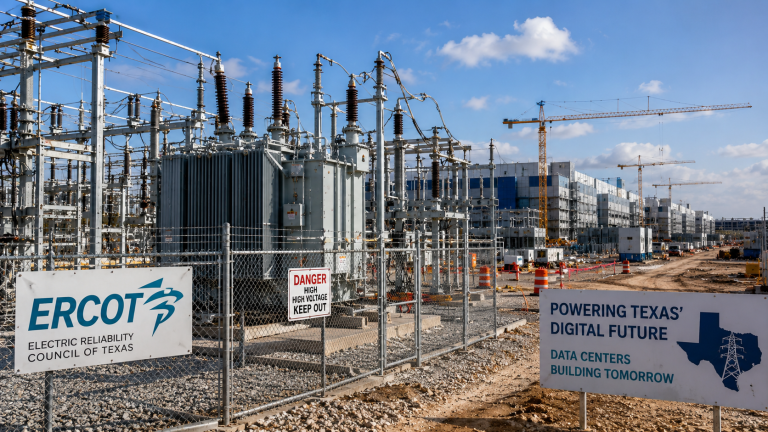
However, Amazon’s application to ERCOT places the project within the state’s large-load process, indicating a peak load of at least 75 MW. The actual completed campus could require considerably more power, but a final figure has not been publicly confirmed.
That distinction is important.
Electrical contractors should be cautious about assuming an eventual megawatt requirement that hasn’t been released.
What is clear is that Texas is experiencing extraordinary demand from proposed data centers.
That has made utility interconnection one of the most important issues facing new developments.
The question is no longer simply:
Can we build the data center?
Increasingly, the question is:
Can we power it?
Amazon Says Data Centers Should Pay Their Own Infrastructure Costs
The debate over who pays for the infrastructure serving massive data centers is becoming increasingly important.
Amazon addressed that issue directly this month.
The company said it agrees that data centers should fully pay for their own energy infrastructure costs rather than shifting those costs onto residential electricity customers.
That policy could have enormous implications for construction.
If developers are responsible for infrastructure required specifically to serve their facilities, the project scope can expand beyond the data center property itself.
New electrical infrastructure might include utility interconnections, transmission improvements, substations, transformers and related equipment.
For electrical contractors, that creates two separate opportunities.
There is the electrical construction inside the data center campus.
And there is the electrical construction required to bring power to the campus.
In some cases, the second opportunity could become nearly as important as the first.
Construction Is Moving Quickly
The state filings also demonstrate how aggressively Amazon is moving.
Project Eagle Building A was registered with an estimated construction start date of August 1, 2026, with completion listed for January 1, 2027.
Several of the later buildings are listed with construction beginning September 1, 2026 and completion scheduled for September 1, 2027.
Schedules can change.
Large projects frequently do.
But the filings demonstrate the speed developers are seeking.
That creates another major issue for electrical contractors:
procurement.
A contractor may be able to mobilize electricians quickly.
Manufacturers cannot necessarily produce large transformers, switchgear and generators just as quickly.
Long-Lead Equipment Could Determine the Schedule
Electrical equipment has become one of the biggest schedule risks on major construction projects.
Data centers make that challenge even more serious.
Consider a project requiring multiple medium-voltage switchgear lineups, transformers, generators and UPS systems.
Those components can’t simply be purchased at a local supply house.
They must be engineered.
Approved.
Manufactured.
Tested.
Shipped.
Installed.
Commissioned.
The electrical contractor may therefore need to begin procurement long before large portions of the building are ready.
That changes how projects are estimated and managed.
The estimator isn’t simply calculating material and labor.
The estimating team may also need to identify:
Manufacturer lead times.
Escalation exposure.
Approved equivalents.
Release dates.
Factory testing requirements.
Shipping requirements.
Temporary power needs.
Storage requirements.
Commissioning schedules.
A missed equipment release date can potentially affect an entire data center schedule.
Repeatable Buildings Create Prefabrication Opportunities
Project Eagle provides another clue about how data center construction is evolving.
The registered buildings are remarkably similar.
Multiple buildings are listed at approximately 189,060 square feet with estimated construction costs of $300 million each.
That repetition creates an opportunity for standardization.
Once an electrical contractor successfully builds the first building, many processes may potentially be repeated.
Conduit racks can be prefabricated.
Equipment layouts can be standardized.
Cable assemblies can be prepared.
Electrical rooms can potentially be modularized.
Material packages can be organized by area.
Labor productivity data from the first building can improve estimates for later buildings.
The contractor begins moving away from treating every building as a completely unique construction project.
Instead, the campus becomes a repeatable production process.
That can produce major productivity improvements.
The First 10 Buildings Alone Represent $3 Billion in Registered Construction
The numbers deserve another look.
Ten buildings.
Approximately 189,060 square feet each.
Approximately $300 million in registered construction cost each.
That produces roughly:
1,890,600 square feet
and
$3 billion in listed construction costs.
The total proposed campus investment has been reported at approximately $10 billion.
Those figures help explain why contractors are paying so much attention to data centers.
Even if electrical work represents only a portion of total construction spending, the potential electrical packages on developments of this size can be enormous.
Thousands of Construction Jobs Could Be Created
Project Eagle is also expected to become an important source of construction employment.
Reporting on the development indicates Amazon expects the campus to create thousands of temporary construction jobs, with at least 150 permanent positions expected by 2027 and potentially hundreds more as the campus grows.
That construction workforce will include far more than electricians.
But electrical construction is one of the most labor-intensive and technically demanding components of a hyperscale data center.
Projects require electricians, foremen, general foremen, superintendents, project managers, estimators, BIM specialists, engineers, controls technicians, testing technicians and commissioning specialists.
And when multiple large campuses are constructed simultaneously, those workers become increasingly difficult to find.
Rural Data Center Construction Creates a Labor Challenge
Boling is a small community.
That matters.
Building a huge data center near a major metropolitan area is one thing.
Building a multi-billion-dollar campus in a rural area creates different logistical challenges.
Contractors may need to recruit workers from a much larger region.
Some workers may require significant travel.
Temporary housing can become an issue.
Per diem can affect labor costs.
Transportation can affect productivity.
Supervision becomes critical.
Material staging requires planning.
Local subcontractor capacity may be limited.
For estimators, these conditions must be reflected in the bid.
Using standard labor assumptions from a project 20 minutes from a major city could produce an unrealistic estimate for a remote project requiring hundreds of electricians.
Amazon’s Texas Expansion Goes Beyond Project Eagle
Project Eagle is also not Amazon’s only Texas data center initiative.
AWS has been pursuing other large campuses across the state.
Recent filings and land acquisitions have connected the company with projects or potential projects in Bastrop County, Pecos County and other Texas markets.
Amazon announced this month that its planned Pecos County data center campus will initially use new onsite generation rather than relying entirely on immediate grid-connected service.
The company says the campus is designed to transition toward grid service as interconnection timelines allow. Amazon is also exploring solar generation and battery storage at the site.
That development should get the attention of electrical contractors.
A data center with its own large-scale generation system creates another layer of electrical work.
Now the project isn’t simply a data center.
It is also a power plant.
Onsite Generation Could Create a New Electrical Market
If grid interconnection delays continue, more developers may consider producing some or all of their electricity onsite.
That could require:
- Natural gas generation
- Gas turbines
- Reciprocating generators
- Generator paralleling
- Medium-voltage switchgear
- Microgrid controls
- Battery energy storage
- Transformers
- Protection systems
- Synchronization equipment
- Utility interconnection equipment
This could create an entirely new category of data center electrical construction.
Instead of the utility providing all primary power and generators providing emergency backup, future campuses may use a combination of grid power, onsite generation and energy storage.
Electrical systems become much more sophisticated.
So do the opportunities.
Water Is Becoming Part of Data Center Planning Too
Electricity isn’t the only infrastructure issue facing massive computing facilities.
Cooling requires careful water planning.
For Project Eagle, public reporting indicates the campus could use as much as approximately 163 million gallons of water annually, although plans call for surface water rather than groundwater. Amazon is also working with Kilimo on agricultural water conservation efforts in the region.
Amazon separately says it is working toward becoming water positive by 2030 and has more than 50 projects expected to return 5.8 billion gallons annually to communities.
For electrical contractors, water may seem unrelated.
It isn’t.
Cooling design affects electrical load.
Mechanical systems affect electrical distribution.
Pump systems require power.
Cooling technologies influence generator sizing, switchgear loading and overall facility demand.
In a data center, electrical and mechanical design are deeply connected.
Electrical Estimators Should Study These Projects Now
Even contractors that aren’t currently bidding hyperscale data centers should study projects such as Project Eagle.
They reveal where electrical construction is heading.
Estimators should become increasingly comfortable with:
Medium-voltage distribution.
Large generator systems.
UPS systems.
Busway.
Large transformers.
Paralleling equipment.
Electrical equipment procurement.
Mission-critical redundancy.
BIM coordination.
Prefabrication.
Testing.
Commissioning.
High-voltage utility coordination.
These skills won’t be limited to data centers.
Advanced manufacturing, semiconductor plants, battery factories and other major industrial projects require many of the same capabilities.
Amazon Is Making a Massive Bet on AI Infrastructure
Project Eagle also has to be viewed within Amazon’s broader capital spending.
Amazon CEO Andy Jassy has said the company expects to invest approximately $200 billion in capital expenditures during 2026, much of it connected to AWS infrastructure and artificial intelligence opportunities.
Jassy said Amazon already has customer commitments supporting a substantial portion of expected AWS capital spending.
Amazon has also announced up to $50 billion in additional investment to expand AI and high-performance computing infrastructure for U.S. government customers, including nearly 1.3 GW of additional compute capacity.
Project Eagle is therefore part of a much larger infrastructure buildout.
And Amazon is only one company.
AI Is Becoming a Physical Construction Industry
Artificial intelligence often sounds like an entirely digital business.
It isn’t.
AI requires physical infrastructure on an enormous scale.
It requires land.
Buildings.
Servers.
Cooling.
Generators.
Transformers.
Switchgear.
Substations.
Transmission.
And electricians.
Project Eagle makes that reality difficult to ignore.
At least 10 large data center buildings are now registered in Texas, representing approximately 1.89 million square feet and $3 billion in listed construction costs, while the broader campus has been reported as an investment of approximately $10 billion.
For electrical contractors, this is exactly the type of project worth watching.
Not because every contractor will bid Amazon’s next hyperscale campus.
Most won’t.
But projects like this show where billions of dollars in construction spending are heading.
Data centers need extraordinary amounts of electrical infrastructure.
The grid needs to expand around them.
Manufacturers need to produce the equipment.
Electrical contractors need to install it.
And skilled electricians need to make all of it work.
The AI revolution may have started with software.
But increasingly, it is being built by the electrical construction industry.
Texas has become one of America’s hottest construction markets for data centers.
Now the state has hit the brakes.
On August 3, 2026, Texas Gov. Greg Abbott directed the Public Utility Commission of Texas and the Electric Reliability Council of Texas, better known as ERCOT, to conduct a comprehensive audit of data centers moving through the state’s grid interconnection process.
Until that verification is completed, affected data center projects cannot move forward through the approval process.
The reason is staggering.
ERCOT is dealing with more than 474 gigawatts of proposed electricity demand from projects seeking connections to the Texas grid. Abbott said approximately 90% of those requests are associated with data centers.
For electrical contractors, estimators and project managers, the story is much bigger than a temporary pause.
Texas is demonstrating what may become one of the defining problems of the AI construction boom:
Developers can build data centers faster than utilities can build the electrical infrastructure required to power them.
474 Gigawatts Is an Extraordinary Number
It is difficult to understand the scale of 474 GW without putting it into perspective.
One gigawatt equals 1,000 megawatts.
So 474 GW equals:
474,000 megawatts.
ERCOT’s existing record peak electricity demand is only a fraction of that amount. Abbott’s office said the interconnection requests represent more than five times the Texas grid’s record peak electricity demand.
Nobody expects every proposed project in the queue to actually be built.
Some proposals are speculative. Others may be duplicates. Some developers may abandon projects because of financing, permitting, power availability or other problems.
But even after accounting for projects that will never reach construction, the amount of proposed electrical load is extraordinary.
The Texas Tribune reported that more than 1,800 individual projects have entered the large-load queue in recent years, with roughly 90% involving data centers.
The number of requests became so large that Texas had to rethink how it studies major electrical loads.
Texas Created a New Process for Massive Electrical Loads
Before the current wave of data center development, utilities could generally study major load additions individually.
That approach becomes difficult when hundreds of enormous projects arrive simultaneously.
ERCOT and the Public Utility Commission responded by developing a process known as Batch Zero.
Instead of studying qualifying large loads one at a time, ERCOT can evaluate them together.
The PUCT approved the Batch Zero process in June 2026 for large electricity users of 75 MW and greater.
The objective is to determine how many large projects the grid can reliably support, where those projects can connect and what transmission upgrades will be necessary.
That last part should be especially interesting to electrical contractors.
Data centers don’t simply require electrical service.
They can require entirely new electrical infrastructure.
A Data Center Can Require the Electrical Infrastructure of a Small City
Traditional commercial construction has trained many electrical contractors to think in terms of amperage.
A building might have a 2,000-amp service.
A larger facility might have a 4,000-amp service.
Industrial facilities can be considerably larger.
But hyperscale data centers change the conversation from amps to megawatts.
Some proposed campuses are measured in hundreds of megawatts.
Others can approach or exceed a gigawatt.
At that scale, the project isn’t simply connecting a building to an existing utility feeder.
The developer may need major utility infrastructure.
That can include:
- New transmission lines
- Transmission line extensions
- New substations
- Substation expansions
- Large power transformers
- Medium-voltage distribution
- High-voltage switchgear
- Protection and relaying
- SCADA and control systems
- Backup generators
- UPS systems
- Battery energy storage
- Busway
- Grounding systems
- Fiber and communications infrastructure
A single data center campus can therefore trigger multiple electrical construction projects.
And Texas potentially has hundreds of these facilities trying to move forward.
The Audit Could Cover 250 to 300 Projects
Abbott’s order initially created some uncertainty about exactly how many projects would be audited.
More details emerged afterward.
ERCOT officials told the Public Utility Commission that approximately 250 to 300 projects would be involved in the immediate verification effort, with most being data centers.
Those projects represent roughly 200 GW of potential future demand.
That alone is more than twice ERCOT’s recent record peak demand.
The audit effectively moves verification to the beginning of the process.
ERCOT wants more confidence that projects entering detailed interconnection studies are legitimate and sufficiently developed.
That is important because an interconnection study requires time and engineering resources.
Studying hundreds of projects that never get built can distort demand forecasts and consume resources that could be devoted to projects with a realistic path to construction.
What Texas Wants to Know About Data Centers
Abbott’s directive goes beyond asking developers how much electricity they want.
Texas officials want considerably more information.
According to the governor’s directive and reporting from the Texas Tribune, developers may be required to provide information concerning:
Electricity consumption.
Onsite power generation.
Water consumption.
Cooling systems.
Tax incentives.
Facility ownership.
Local community impacts.
Measures intended to reduce those impacts.
Projects that fail to comply with applicable requirements can be denied a connection to the Texas grid.
This creates another consideration for electrical contractors pursuing data center work.
The future of these projects may depend increasingly on the developer’s complete infrastructure strategy—not simply construction financing and real estate.
Texas Already Passed Major Large-Load Legislation
The audit isn’t happening in isolation.
Texas lawmakers have already recognized that enormous new electrical loads require new rules.
Senate Bill 6 was developed to address the state’s rapidly changing electricity-demand outlook.
According to the Texas Legislature’s analysis, ERCOT previously estimated 130–150 GW of additional load growth by 2030.
For comparison, ERCOT’s 2024 peak load was approximately 86 GW.
SB 6 focused on four major areas:
Transmission cost allocation.
Grid reliability.
More credible load forecasting.
Requirements for large loads to participate in load shedding during shortages.
That matters to electrical contractors because the relationship between large electrical customers and utilities is changing.
A 500-MW data center cannot necessarily be treated like an ordinary customer.
It can materially affect the regional grid.
The Electrical Load Pipeline Keeps Growing
ERCOT’s own data shows how quickly the large-load market has changed.
A January 2026 ERCOT report showed projected large-load totals rising dramatically through the end of the decade.
The figures included approximately:
26.8 GW in 2026
81.7 GW in 2027
145.7 GW in 2028
188.8 GW in 2029
232.5 GW in 2030
The same ERCOT report showed 92 proposed projects larger than 1,000 MW each, representing more than 140 GW of requested load.
Again, those figures should not be interpreted as a prediction that every project will actually be constructed.
ERCOT’s queue contains projects at different stages of development.
But it illustrates the magnitude of what utilities are being asked to evaluate.
A 1,000-MW project is a one-gigawatt electrical load.
And ERCOT’s data showed dozens of proposed projects at that scale.
Electrical Contractors Should Pay Attention to the 75-MW Threshold
One particularly important number is 75 MW.
ERCOT’s Batch Zero framework covers qualifying large projects of 75 MW and greater.
For perspective, 75 MW represents 75 million watts of electrical demand.
Even the smallest projects entering this process are enormous by normal commercial construction standards.
The electrical equipment packages associated with projects of this size can be substantial.
Medium-voltage switchgear alone can represent major procurement packages.
Then add transformers.
Generators.
UPS systems.
Busway.
Cable.
Conduit.
Controls.
Grounding.
Fire alarm.
Security.
Communications.
Testing.
Commissioning.
The construction opportunities become significant very quickly.
Grid Capacity Could Determine Where Data Centers Get Built
For decades, major construction projects were often driven primarily by land availability, taxes, workforce, transportation and proximity to customers.
Data centers are adding another major factor:
available megawatts.
A developer might find inexpensive land and a business-friendly community.
That doesn’t matter if 300 MW of electricity cannot be delivered to the property.
Electrical infrastructure can therefore become one of the first considerations in site selection.
This could also change land values.
Property near substations and strong transmission infrastructure may become increasingly attractive for industrial and data center development.
Locations with insufficient transmission capacity may struggle to attract projects regardless of other advantages.
Onsite Power Generation Could Become More Important
There is another fascinating development in Texas.
Some data centers are exploring or constructing onsite power generation.
The Texas Tribune noted that facilities using their own generation may be able to reduce their dependence on traditional grid connections.
That could open another major electrical construction market.
A large onsite generation system can require:
- Natural gas generators
- Gas turbines
- Reciprocating engines
- Paralleling switchgear
- Medium-voltage distribution
- Transformers
- Microgrid controls
- Battery storage
- Protection systems
- Synchronization equipment
- Utility interconnection equipment
The data center of the future may increasingly resemble a combination of an industrial facility and a private power plant.
For electrical contractors with generation and medium-voltage expertise, that could create significant opportunities.
Transmission Construction May Be the Bigger Opportunity
The data center itself receives most of the attention.
But contractors should watch what happens outside the fence.
If Texas eventually approves even a fraction of the proposed load, enormous quantities of electrical infrastructure will have to be constructed.
ERCOT’s Batch Zero process is specifically designed to determine available grid capacity and identify the transmission improvements needed to connect large customers.
That could mean:
New transmission corridors.
New substations.
Larger transformers.
Substation expansions.
Reconductor projects.
Additional generation.
Grid-scale battery storage.
Protection and control upgrades.
The supporting infrastructure could become as important as construction of the data centers themselves.
Reliability Remains the Central Issue
Texas has good reason to proceed carefully.
A U.S. Department of Energy reliability assessment found that increasing large-load demand from data centers, Bitcoin mining, industrial facilities and oil-and-gas operations is a significant factor affecting future ERCOT reliability.
The assessment noted more than 20 GW of newly contracted large loads expected by 2028, in addition to other organic demand growth.
Utilities cannot simply connect unlimited new loads and hope enough generation and transmission eventually appears.
The system has to remain reliable throughout the transition.
That means the timing of new loads must be coordinated with the construction of the infrastructure serving them.
This Is a Warning for Electrical Estimators
The Texas situation also carries an important lesson for electrical estimators.
A project appearing on a bid board does not necessarily mean the project has secured adequate utility capacity.
That question should be asked early.
Before investing significant estimating resources into a large data center or industrial project, contractors should understand:
Has utility power been secured?
What is the available capacity?
Has an interconnection agreement been executed?
Is a new utility substation required?
Who pays for transmission improvements?
Who owns the substation?
When will utility power become available?
Is temporary generation required?
Is permanent onsite generation planned?
What electrical equipment has already been released?
Are transformer and switchgear lead times incorporated into the schedule?
Those questions can affect millions of dollars.
The Texas Pause Doesn’t Mean the Data Center Boom Is Over
The August 2026 decision should not be interpreted as Texas abandoning data center development.
Quite the opposite.
Texas is attempting to determine which projects are real, how much power they actually require and how they can be connected without threatening grid reliability.
The scale of the demand forced the state to create a more disciplined process.
ERCOT is aiming to complete the current verification work and continue the Batch Zero process. Current plans call for a comprehensive audit report to be filed with the PUCT in December.
The projects that survive that process could provide a clearer picture of the actual construction pipeline.
For contractors, that could be extremely valuable.
The Data Center Boom Is Becoming a Power Infrastructure Boom
Texas may be giving the rest of the United States an early look at the future.
Artificial intelligence is driving demand for enormous computing facilities.
Those facilities require extraordinary amounts of electricity.
Utilities must build infrastructure to deliver it.
Manufacturers must produce the transformers, switchgear and generators.
Engineers must design the systems.
And electrical contractors must install them.
Texas now has more than 474 GW of proposed load requests in ERCOT’s queue, with data centers accounting for the overwhelming majority, according to state officials.
Not all of those projects will be built.
They don’t need to be.
Even a fraction of that demand would require massive investment in generation, transmission, substations and electrical distribution.
The Texas data center pause therefore isn’t necessarily bad news for electrical construction.
It is evidence that demand has become so large that the electrical grid itself is becoming the limiting factor.
For electrical contractors, the message is clear:
The next phase of the data center boom won’t be determined only by who can build the buildings.
It will be determined by who can deliver the power.
America has a growing electricity problem.
The country needs more power. But generating more electricity is only part of the challenge.
That electricity also has to get where it is needed.
During the first half of 2026, congestion costs on PJM Interconnection—the largest power grid in the United States—surged to approximately $6 billion, according to PJM’s independent market monitor. That represented a 43% increase as overloaded transmission lines increasingly limited the movement of electricity across the system.
For electrical contractors, this is much more than an electricity-market story.
It points toward a potentially enormous construction opportunity involving transmission lines, substations, switchyards, transformers, protection systems and other high-voltage infrastructure.
The United States is rapidly adding data centers and other large electrical loads.
Now the infrastructure carrying all that electricity has to catch up.
What Is Happening to the PJM Power Grid?
PJM Interconnection operates the high-voltage electric grid serving approximately 67 million people.
Its territory stretches across all or portions of Delaware, Illinois, Indiana, Kentucky, Maryland, Michigan, New Jersey, North Carolina, Ohio, Pennsylvania, Tennessee, Virginia and West Virginia, along with Washington, D.C.
PJM coordinates approximately 88,000 miles of transmission lines across its territory.
That makes what is happening inside PJM especially important.
Problems appearing there could provide an early look at challenges other regions may eventually face.
According to Monitoring Analytics, transmission congestion costs reached approximately $6 billion during the first six months of 2026.
The year-over-year increase was approximately $3.9 billion.
For comparison, the increase in natural-gas fuel costs during the same period was about $2 billion. In other words, the additional cost associated with transmission constraints was greater than the increase associated with fuel.
That is a remarkable development.
Generating electricity is one thing.
Moving it across an increasingly constrained transmission network is becoming another major expense.
What Is Transmission Congestion?
Think of the electrical transmission system like a highway.
A highway may have plenty of cars available to make a trip. But if the road cannot handle the traffic, congestion develops.
The electric grid works in a similar way.
Power plants may be capable of generating electricity. However, transmission lines have operating limits.
When a transmission path becomes constrained, grid operators may not be able to use the lowest-cost available generation to serve customers in another area.
They may have to use more expensive generation closer to the load.
Those constraints create congestion costs.
As demand increases, the problem becomes more serious if transmission capacity does not increase with it.
And demand is increasing rapidly.
500-kV Transmission Constraints Are Sending a Warning
One of the most striking numbers in the latest PJM report involves its highest-voltage transmission network.
During the first half of 2025, PJM recorded 1,865 five-minute periods when 500-kV transmission lines hit or exceeded operating limits.
During the first half of 2026?
8,920.
Many of those violations occurred during a winter storm, according to Monitoring Analytics.
The increase illustrates how quickly conditions can deteriorate when extreme weather and rising electrical demand hit the grid simultaneously.
The economic consequences are also substantial.
PJM’s real-time wholesale cost to serve electricity demand increased from approximately $20.4 billion during the first half of 2025 to $29.4 billion during the first half of 2026.
Average real-time wholesale electricity prices increased from $51.75 per megawatt-hour to $72.54 per megawatt-hour.
The transmission system is becoming a critical part of the power-cost equation.
Data Centers Are Adding Enormous New Electrical Loads
There are several reasons electricity demand is increasing.
Manufacturing is expanding in some regions.
Electric vehicles add load.
Electrification adds load.
Heating and cooling demand continues to grow.
But one category stands above many others:
Data centers.
PJM has said forecast electricity demand from data centers and other large-load customers is growing faster than the ability to build enough new generation to serve those customers.
PJM’s planning data has projected that data-center growth could add as much as approximately 30 GW of electrical demand between 2025 and 2030.
Thirty gigawatts is 30,000 megawatts.
To put that into construction terms, these aren’t ordinary commercial electrical services.
A single large data center campus can require hundreds of megawatts.
That means utilities and developers must think beyond the building.
Where will the power come from?
Can the existing transmission system deliver it?
Does a new substation need to be constructed?
Do existing substations require expansion?
Are new transmission lines required?
Can existing lines be reconductored?
Are new transformers required?
Does additional generation need to be built?
Those questions increasingly determine whether a major project can proceed.
Northern Virginia Shows What Happens When Data Centers Concentrate
Northern Virginia is one of the most important data center markets in the world.
It is also one of the areas being hit hard by transmission congestion.
Reuters identified northern Virginia, metro Baltimore and Delaware among areas experiencing significant PJM congestion.
This matters because Northern Virginia demonstrates what can happen when enormous electrical loads become concentrated geographically.
Data centers may be located relatively close together.
Each requires large quantities of power.
The surrounding transmission network must support those loads.
Eventually, the problem moves upstream.
It is no longer simply about installing another transformer or expanding a local distribution feeder.
The regional transmission system itself may require reinforcement.
That creates a completely different scale of electrical construction.
PJM Is Already Planning Billions in Transmission Improvements
The construction response has already started.
PJM said its Board approved approximately $6 billion of transmission projects in February 2025 to address reliability needs created by accelerated load growth, changes in generation and shifting regional power flows.
And that was only one group of projects.
The Maryland Office of People’s Counsel reported that PJM subsequently approved approximately $11.8 billion of transmission projects in its 2025 Regional Transmission Expansion Plan, following $6.7 billion in its 2024 RTEP.
Those numbers should get the attention of electrical construction companies.
Transmission expansion creates work far beyond the transmission conductors themselves.
Projects can require:
- New transmission substations
- Existing substation expansions
- High-voltage breakers
- Power transformers
- Control houses
- Protection and relay systems
- SCADA systems
- Underground transmission
- Overhead transmission
- Structural steel
- Ground grids
- Station service
- Battery systems
- Fiber-optic communications
- Testing and commissioning
Large transmission programs can also create opportunities for civil contractors, equipment manufacturers, specialty subcontractors and engineering firms.
The Federal Government Says More Transmission Is Needed
This isn’t only a PJM issue.
The U.S. Department of Energy released its draft 2026 National Transmission Needs Study in July.
DOE concluded there is a pressing need for additional transmission infrastructure because of load growth from data centers, domestic manufacturing, large industrial loads and overall economic growth.
That is significant.
Electrical demand had remained relatively flat in many parts of the United States for years.
Utilities could plan around relatively predictable growth.
That environment is changing.
A single proposed data center campus can introduce an electrical load comparable to a small city.
Multiple campuses can transform the load forecast of an entire utility territory.
Utilities then have to determine how generation and transmission infrastructure will support them.
Extreme Weather Makes the Problem Even Harder
The grid must handle more than average demand.
It must survive peak conditions.
That became clear during the July 2026 heat wave.
PJM reached an all-time peak load of approximately 168 GW on July 2, according to Reuters.
During the event, PJM took emergency measures, ordered generators to maximize output and prepared additional actions to maintain reliability. Operating reserves fell sharply as demand climbed.
At one point, the cost of balancing electricity on the system reportedly reached as high as $28,000 per megawatt.
The grid made it through the event.
But the episode demonstrated why utilities cannot simply build enough infrastructure to meet an average day.
The electrical system must be capable of handling extreme conditions.
That requires capacity.
It requires redundancy.
And increasingly, it requires construction.
Electrical Contractors Should Watch the Transmission Market
For many commercial electrical contractors, transmission construction may seem like a completely different industry.
In some ways, it is.
High-voltage transmission and substation work requires specialized expertise, equipment, safety programs and trained personnel.
But the infrastructure expansion can create opportunities throughout the electrical construction market.
Consider what happens when a major data center campus is announced.
A utility may need to build a new transmission line.
That transmission line may feed a new substation.
The substation may require multiple power transformers.
The developer may then construct its own medium-voltage distribution system.
That system feeds multiple data center buildings.
Each building requires switchgear, generators, UPS systems, busway, cable, controls and monitoring.
One large load can create an entire chain of electrical construction projects.
Equipment Demand Could Become Another Major Challenge
Building billions of dollars in transmission infrastructure requires equipment.
Lots of it.
Large power transformers are already experiencing supply-chain pressure.
Switchgear remains critical.
High-voltage breakers, instrument transformers, relays, steel and conductors must all be manufactured and delivered.
That makes procurement increasingly important for electrical estimators and project managers.
On a large infrastructure project, the lowest equipment quotation may not necessarily be the best quotation.
Contractors increasingly need to evaluate:
Price.
Lead time.
Escalation.
Manufacturing capacity.
Approved manufacturers.
Delivery guarantees.
Schedule risk.
A transformer that costs less but arrives 18 months too late can become extremely expensive.
Technology Can Help, But Construction Is Still Needed
The industry is also looking for ways to get more capacity from existing transmission infrastructure.
Dynamic line ratings, advanced grid modeling and other grid-enhancing technologies can potentially allow operators to use existing lines more efficiently under certain conditions.
Reuters reported that technologies from companies working in this area could help reduce congestion without waiting for every new transmission project to be completed.
That could provide valuable short-term relief.
But software cannot eliminate the underlying physical problem.
If electricity demand continues growing by tens of gigawatts, additional physical infrastructure will still be required.
Lines.
Substations.
Transformers.
Switchgear.
Generation.
And the electrical workforce needed to install it.
The Grid Could Become One of Electrical Construction’s Biggest Markets
The most important part of the $6 billion PJM congestion story isn’t the $6 billion.
It is what the number represents.
America’s electrical demand is changing faster than much of the infrastructure built to serve it.
Data centers are accelerating that change.
Manufacturing is adding additional demand.
Extreme weather creates enormous peaks.
Meanwhile, major transmission projects can take years to permit, engineer and construct.
PJM itself says electricity demand from large-load customers is outpacing the ability to build enough generation to serve them.
The Department of Energy says the country has a pressing need for additional transmission infrastructure.
And PJM congestion costs reached approximately $6 billion in only six months.
Put those facts together and the direction becomes difficult to ignore.
The United States needs more power infrastructure.
A lot more.
For electrical contractors, estimators, project managers, engineers and equipment manufacturers, the next major construction boom may not simply be inside the data center.
It may be the massive electrical grid being built around it.
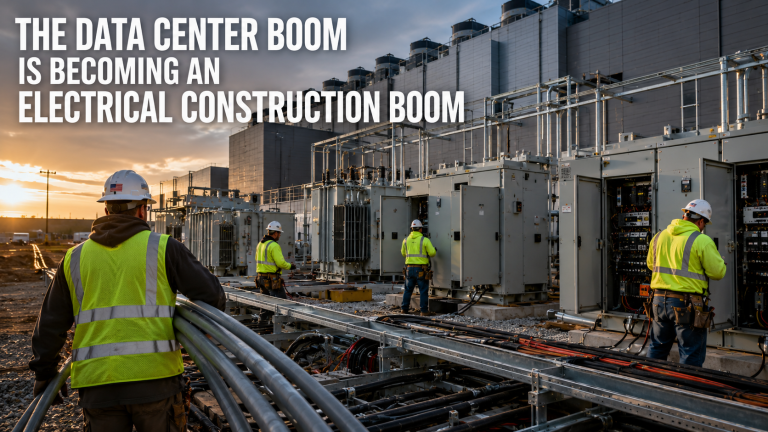
Artificial intelligence is creating something much larger than a technology boom.
It is creating an electrical construction boom.
Across the United States, billions of dollars are flowing into new data centers and the infrastructure required to power them. These facilities require enormous electrical systems, including substations, transformers, medium-voltage distribution, switchgear, generators, UPS systems, busway, cable, controls and grounding systems.
For electrical contractors, estimators, project managers and suppliers, this could become one of the most important construction markets of the decade.
The evidence is already appearing throughout the electrical supply chain.
Reuters reported on August 19, 2026, that manufacturers ranging from generator companies to transformer and cable suppliers are benefiting from the rapid expansion of U.S. data centers. One of the clearest examples is Generac, which is investing heavily to increase production of large commercial generators used by data centers.
But generators represent only one part of a much larger opportunity.
Generac’s $1.6 Billion Data Center Backlog Shows the Scale of Demand
Consider what is happening at Generac.
Generac has traditionally been widely associated with standby generators for homes and businesses. Now the company is becoming a significant supplier to the hyperscale data center market.
Generac reported that its backlog for products serving data centers had reached approximately $1.6 billion by July 29, 2026. The company also said it received approximately $1 billion in additional orders from new and existing customers since its previous update.
That is not speculative future demand.
Those are orders.
Generac also finalized product-specific terms under an agreement with a hyperscale data center operator that committed nearly $700 million of volume for 2027. The company announced another global supply agreement with a second hyperscale customer in June.
The effect is showing up in Generac’s financial results.
Commercial and Industrial segment external sales increased approximately 29% in the second quarter of 2026, reaching $556 million compared with $431 million during the same period a year earlier. Generac said the increase was primarily driven by growing revenue from products sold into the global data center market.
Reuters reports that Generac plans to spend approximately $250 million by the end of 2027 to equip multiple factories to manufacture larger generators for data centers. The expansion is also expected to add approximately 1,000 workers.
For electrical contractors, those numbers provide an important signal.
The data center construction boom is moving downstream into the entire electrical construction supply chain.
Data Centers Require Enormous Electrical Systems
A data center is fundamentally different from most commercial buildings.
An office building might require several thousand amps of electrical service.
A hyperscale data center campus can require hundreds of megawatts.
That changes everything.
The electrical infrastructure can include utility substations, high-voltage transmission connections, medium-voltage distribution, transformers, switchgear, paralleling switchgear, backup generators, UPS systems, battery energy storage, automatic transfer equipment, power distribution units, busway, large feeder systems, grounding and bonding systems, sophisticated monitoring and controls.
Redundancy makes the systems even larger.
Mission-critical facilities cannot simply shut down when utility power disappears. Electrical systems are therefore designed around reliability, backup power and multiple distribution paths.
That means tremendous quantities of electrical equipment.
And somebody has to install it.
Electrical Equipment Demand Could Double
The scale of the opportunity becomes clearer when looking at forecasts for electrical equipment.
Wood Mackenzie projects that the U.S. data-center electrical equipment market could grow from approximately $33 billion in 2025 to $66 billion by 2030, according to Reuters.
That would essentially double the market in five years.
Electrical contractors should pay close attention to what that number represents.
It isn’t merely servers.
It includes the infrastructure required to deliver, distribute, condition and protect enormous quantities of electrical power.
Reuters has separately reported that surging data center demand is contributing to shortages of critical electrical equipment, particularly large power transformers. Utilities and developers are responding by securing equipment earlier and diversifying their supply chains.
For electrical estimators, procurement may increasingly become part of estimating strategy.
A contractor could accurately estimate the labor and material cost of a project and still face serious problems if critical electrical equipment cannot arrive when needed.
The Power Demand Is Extraordinary
The International Energy Agency expects data centers to become one of the major drivers of electricity-demand growth.
According to the IEA’s Electricity 2026 analysis, U.S. electricity consumption is expected to increase by more than 420 terawatt-hours over the next five years. Data centers are projected to account for approximately half of U.S. electricity-demand growth through 2030.
The trend is already visible.
The IEA reports that U.S. electricity demand grew approximately 2% in 2025. Data centers alone accounted for roughly half of the country’s increase in electricity consumption.
Globally, the IEA projects data center electricity consumption will roughly double by 2030.
That creates an important distinction.
This isn’t simply a data center construction boom.
It is a power infrastructure construction boom.
Building the Data Center May Be Easier Than Powering It
One of the biggest challenges facing developers is obtaining utility power.
Electrical Contractor reported in August 2026 that constructing the shell of a data center commonly takes approximately 18–24 months, while obtaining the required power can take considerably longer.
The publication cited a national average wait of approximately four years for power and an average wait of seven years for a 100-MW connection.
Think about that difference.
The building can potentially be constructed years before the utility can deliver enough electricity to operate it.
This creates opportunities far beyond traditional building electrical construction.
Utilities will need generation.
Transmission systems will need expansion.
New substations will need to be constructed.
Existing substations will require upgrades.
Distribution networks will need reinforcement.
Developers may also look toward onsite generation, microgrids, battery storage and other power solutions.
Electrical contractors capable of working across these systems could find themselves in an extremely strong position.
Transformers and Switchgear Could Remain Critical Bottlenecks
Electrical contractors have already experienced difficult equipment markets over the past several years.
Data center construction adds another massive source of demand.
Transformers are particularly important.
Reuters reported in July that rapidly growing AI data center demand was worsening shortages of critical U.S. grid equipment, with large power transformers facing particularly severe constraints.
The problem has direct consequences for estimating.
Historically, an estimator could obtain quotations from electrical suppliers, carry the equipment cost and move forward.
That process is becoming more complicated.
Estimators increasingly need to ask:
How long is the quotation valid?
What is the manufacturing lead time?
Can the manufacturer guarantee the delivery date?
Does the price include escalation?
Can equivalent equipment be substituted?
Will the owner allow approved alternates?
When must the equipment be released?
What happens if the construction schedule moves?
On large electrical projects, procurement strategy can now be almost as important as labor productivity.
Modular Electrical Construction Will Continue Growing
Another important development is modular construction.
Electrical Contractor reported this month that modular construction is helping support rapid data center expansion, with much of the new development expected outside traditional technology hubs. Approximately 67% of the new group of data centers cited in the report are expected in rural areas, with significant growth anticipated across the Midwest and South.
Electrical contractors should watch this carefully.
Data centers are well suited for prefabrication.
Electrical assemblies can be built under controlled conditions and delivered to the project ready for installation.
That can include:
- Electrical skids
- Equipment racks
- Conduit assemblies
- Cable tray assemblies
- Busway systems
- Modular power rooms
- Switchgear lineups
- Generator packages
- UPS assemblies
- Prefabricated electrical rooms
The contractors that invest in prefabrication, BIM, digital coordination and repeatable installation processes may gain an advantage as data center schedules become increasingly aggressive.
Data Centers Could Create Opportunities for Contractors of Different Sizes
It is easy to assume that only the largest national electrical contractors can benefit from hyperscale data center construction.
The prime electrical packages will certainly favor contractors capable of handling very large projects.
But the opportunity spreads much further.
Large projects require subcontractors.
They require temporary power.
They require site utilities.
They require underground electrical systems.
They require communications contractors.
They require security systems.
They require testing companies.
They require commissioning.
They require generator technicians.
They require maintenance contractors.
They require local labor.
And every new data center creates supporting infrastructure around it.
Reuters’ reporting illustrates how widely the economic effects are spreading. Manufacturers of generators, cooling systems, transformers, cables, construction equipment and even prefabricated building components are seeing increased demand tied to data center development.
The opportunity extends far beyond the data center walls.
Electrical Contractors Should Prepare Now
Contractors interested in this market should not wait until a 500,000-square-foot data center appears on a bid board.
Preparation should begin before the invitation to bid arrives.
Companies should develop estimating knowledge around medium-voltage distribution, generator systems, UPS equipment, busway, switchgear, transformers and mission-critical construction.
Estimators should become comfortable analyzing equipment lead times and escalation risk.
Project managers should understand accelerated schedules and phased equipment releases.
Field operations should explore prefabrication.
Companies should also begin identifying manufacturers, distributors and specialty subcontractors that understand mission-critical work.
The technical requirements are high, but so is the potential market.
The Electrical Contractor May Be at the Center of the AI Revolution
When people discuss artificial intelligence, they usually talk about software, chips and technology companies.
Electrical contractors should look deeper.
Every AI query ultimately depends on physical infrastructure.
Servers require buildings.
Buildings require cooling.
Cooling requires power.
Servers require enormous amounts of power.
That electricity must be generated, transmitted, transformed, distributed, protected and backed up.
Generac’s $1.6 billion data center backlog provides one very visible example of what is happening throughout the industry. Electrical equipment manufacturers are expanding factories. Utilities are planning infrastructure. Developers are searching for available megawatts. Contractors are being asked to build increasingly sophisticated power systems.
Meanwhile, the IEA expects data centers to account for roughly half of U.S. electricity-demand growth through 2030.
Those trends point toward something much larger than another construction niche.
The AI revolution is becoming a power revolution.
And the companies responsible for installing that power infrastructure are electrical contractors.
For contractors, estimators and project managers willing to develop the capabilities required for mission-critical construction, the data center electrical construction boom could become one of the biggest opportunities of the next decade.
Artificial intelligence is rapidly transforming the electrical construction industry. What was once viewed as experimental technology has become a practical business tool that helps contractors estimate projects more accurately, improve communication, reduce administrative work, and make better decisions.
From estimating and project management to scheduling and documentation, electrical contractors across the United States are investing in AI-powered software and digital platforms to remain competitive. Industry organizations, construction technology providers, and engineering firms all report increasing adoption of artificial intelligence as contractors look for ways to improve efficiency while managing labor shortages and growing project complexity. AI is not replacing experienced estimators or project managers—it is giving them better tools to perform their jobs faster and more accurately.
AI Is Changing the Estimating Process
Electrical estimating has always required careful attention to detail.
Estimators must analyze drawings, perform quantity takeoffs, review specifications, price thousands of materials, calculate labor, evaluate subcontractor quotations, and prepare competitive proposals—all while working under tight deadlines.
Today’s AI tools are helping streamline many of these repetitive tasks.
Modern software can assist with:
- Reviewing specifications
- Organizing bid documents
- Identifying missing information
- Summarizing project requirements
- Generating proposal drafts
- Comparing supplier quotations
- Creating bid checklists
- Preparing client correspondence
These capabilities allow estimators to spend more time evaluating project risk and less time performing routine administrative work.
Project Managers Benefit from Automation
Project management has also become more digital.
Instead of relying on paper documents and spreadsheets, many contractors now use cloud-based platforms that provide real-time access to project information from the office or the jobsite.
AI-powered systems help organize:
- RFIs
- Submittals
- Change orders
- Daily reports
- Meeting minutes
- Schedule updates
- Cost reports
- Progress documentation
Some platforms can automatically summarize meetings, generate action items, and identify schedule conflicts before they become major problems.
For project managers overseeing multiple jobs simultaneously, these tools save valuable time while improving communication across the project team.
Building Information Modeling Continues to Expand
Building Information Modeling (BIM) remains one of the most valuable digital technologies in electrical construction.
Three-dimensional coordination allows contractors to detect conflicts before installation begins.
Benefits include:
- Reduced field rework
- Improved coordination
- Better prefabrication
- Faster installation
- More accurate quantities
- Improved scheduling
When combined with AI-assisted design review, BIM helps contractors identify potential issues earlier in the construction process, reducing costly field changes.
AI Does Not Replace Experience
Despite rapid advances in artificial intelligence, industry experts agree that AI is a tool—not a replacement for skilled professionals.
An experienced electrical estimator still provides critical judgment when evaluating:
- Labor productivity
- Constructability
- Project risks
- Material substitutions
- Value engineering
- Customer expectations
- Bid strategy
Likewise, project managers continue making decisions that require leadership, communication, negotiation, and years of construction experience.
AI works best when paired with knowledgeable professionals who understand electrical construction.
Administrative Work Is Becoming Easier
One of the biggest advantages of AI is reducing paperwork.
Contractors are using digital assistants to:
- Draft emails
- Create meeting summaries
- Develop safety documentation
- Organize project files
- Produce training materials
- Write procedures
- Generate reports
Instead of spending hours formatting documents, employees can focus on managing projects and supporting customers.
This increased efficiency is particularly valuable as many companies continue operating with lean office staffs.
Training Becomes More Accessible
Technology is also changing how contractors train employees.
Online learning platforms, interactive videos, AI tutoring, and virtual classrooms make it easier for electricians, estimators, and project managers to continue developing their skills without leaving the office or jobsite.
Many contractors now provide digital training covering:
- Electrical estimating
- Project management
- Safety
- Code updates
- Software instruction
- Leadership development
This flexibility helps companies develop employees while minimizing downtime.
Data Improves Better Decision-Making
Contractors collect enormous amounts of information throughout every project.
AI helps analyze this data to identify trends involving:
- Labor productivity
- Material usage
- Equipment utilization
- Schedule performance
- Budget forecasting
- Change order frequency
These insights allow business owners to make more informed decisions and improve future estimates.
Rather than relying solely on historical experience, contractors can combine years of practical knowledge with real-time project data.
Preparing for the Future
Technology adoption is expected to accelerate over the next several years as AI becomes integrated into more construction software platforms.
Contractors who invest in digital tools today are positioning themselves to compete more effectively for increasingly complex projects, including AI data centers, healthcare facilities, manufacturing plants, and utility infrastructure.
Companies that embrace technology while continuing to develop skilled employees will likely enjoy the greatest long-term success.
Looking Ahead
Artificial intelligence is no longer a future trend—it is becoming part of everyday electrical construction.
The contractors seeing the greatest benefits are those using AI to eliminate repetitive tasks, improve project visibility, and support better decision-making rather than replace experienced professionals.
As technology continues evolving, successful electrical contractors will combine advanced digital tools with skilled estimators, project managers, and electricians. That combination of innovation and experience is expected to define the next generation of electrical construction leadership.
Accurate estimating has always been one of the most important factors in the success of an electrical contractor. In today’s construction market, however, preparing a competitive and profitable estimate has become more challenging than ever. Material prices continue to fluctuate across several major electrical product categories, forcing estimators to monitor costs closely while managing the financial risks associated with long project schedules.
Although inflation has moderated compared to the sharp increases experienced in recent years, pricing uncertainty remains a significant concern throughout the electrical construction industry. Copper, aluminum, transformers, switchgear, cable, conduit, and electrical distribution equipment continue experiencing varying levels of price volatility, long lead times, and regional supply differences. Industry organizations, manufacturers, and construction economists continue advising contractors to carefully manage pricing assumptions throughout the bidding process.
Copper Remains the Biggest Cost Variable
Few materials have a greater impact on an electrical estimate than copper.
Nearly every commercial and industrial electrical project depends on copper conductors, grounding systems, busbars, transformers, and equipment connections. Because copper is traded globally as a commodity, prices can change quickly based on worldwide demand, mining production, manufacturing activity, and international trade.
The continued expansion of AI data centers, electric vehicles, renewable energy projects, battery manufacturing, and utility upgrades has increased global demand for copper. Even modest changes in commodity pricing can significantly affect the total value of large electrical projects.
For electrical estimators, monitoring copper trends has become a routine part of preparing accurate bids. Many firms now update supplier pricing immediately before bid day to minimize exposure to sudden market changes.
Long Lead Times Affect Project Planning
Pricing is only one part of the challenge.
Many electrical products continue experiencing extended manufacturing lead times, particularly large power distribution equipment.
Items commonly affected include:
- Switchgear
- Transformers
- Motor control centers
- Automatic transfer switches
- Busway systems
- Custom electrical equipment
Although availability has improved compared to previous years, contractors continue planning procurement much earlier in the project lifecycle. Delays in receiving critical equipment can affect construction schedules, labor planning, and project profitability.
Project managers and estimators now work more closely than ever to identify long-lead materials during the bidding phase.
Estimators Are Adapting Their Bid Strategies
Material price uncertainty has changed the way many contractors prepare estimates.
Rather than assuming prices will remain stable, estimators increasingly rely on current supplier quotations and maintain frequent communication with distributors leading up to bid day.
Many contractors have also shortened the validity period of their proposals. Instead of guaranteeing prices for several months, bids may remain valid for only 15 to 30 days unless otherwise specified.
Other companies include carefully written escalation clauses on negotiated projects, allowing material price adjustments if significant cost increases occur before procurement.
These practices help reduce financial risk while maintaining transparency with owners and general contractors.
Supplier Relationships Matter More Than Ever
One of the most valuable assets an estimator can have is a strong relationship with electrical distributors.
Reliable suppliers provide:
- Current material pricing
- Lead-time updates
- Product substitutions
- Manufacturer recommendations
- Budget pricing assistance
- Inventory availability
Regular communication allows contractors to identify potential issues before bids are submitted.
Many successful estimators request updated quotations several times before bid deadlines, particularly on large commercial and industrial projects where material costs represent a significant percentage of the overall estimate.
Technology Improves Cost Accuracy
Modern estimating software has helped contractors respond more quickly to changing material costs.
Many estimating platforms now integrate supplier databases, allowing estimators to update pricing more efficiently than in the past.
Cloud-based estimating systems, digital takeoffs, and AI-assisted quantity verification also help improve accuracy while reducing manual data entry.
Although software provides valuable tools, experienced estimators still play the most important role. Understanding market conditions, evaluating supplier quotes, and recognizing pricing risks require professional judgment that cannot be fully automated.
Technology enhances estimating—it does not replace experience.
Owners Are Becoming More Flexible
Project owners have also adapted to today’s pricing environment.
Many negotiated projects now include early procurement strategies that allow contractors to purchase critical equipment before construction begins. This approach helps secure pricing while reducing the risk of future increases.
Some owners are also accepting approved equipment substitutions when equivalent products offer shorter lead times or better availability.
Greater collaboration between owners, contractors, engineers, and suppliers has become increasingly important as projects grow larger and more technically demanding.
What This Means for Electrical Contractors
Successful contractors understand that estimating is no longer simply calculating quantities and applying unit prices.
Today’s estimators must evaluate commodity markets, supply chains, procurement schedules, labor availability, and project risk simultaneously. Companies that actively monitor pricing trends, maintain strong supplier relationships, and communicate openly with customers are better positioned to protect both profitability and client confidence.